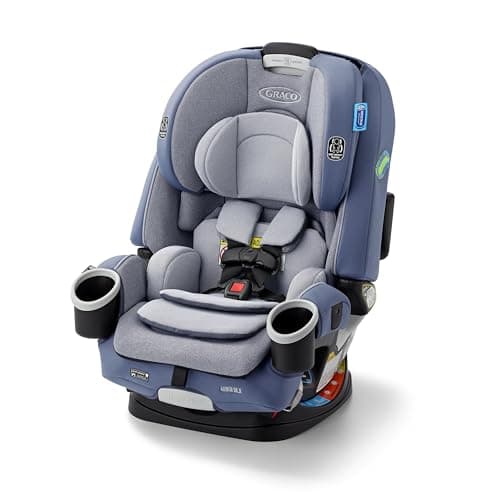
The Graco 4Ever DLX is the seat most American parents picture when they hear "all-in-one": a rear-facing seat for a newborn, a forward-facing harness for a preschooler, then a highback and finally a backless booster, all from one shell that Graco rates for ten years of use. It is our top pick on both the best all-in-one car seats and best convertible car seats roundups, so it has earned a full review of its own. One thing first, in keeping with how we pick: we have not crash-tested this seat or lived with it for a decade. What follows is built from Graco's published specifications and the current Amazon listing, the manual as read by the certified technicians at CarseatBlog, the independent crash-sled data BabyGearLab has published, and the federal standards and pediatric guidance we cite on every car-seat page.
The short verdict
Buy the 4Ever DLX if you want one sensibly priced seat that legally covers every stage from a four-pound newborn to a 120-pound booster rider, installs without drama in most cars, and comes from the best-supported all-in-one platform on the market. Look elsewhere if extended rear-facing is your first priority (the 4Ever stops at 40 pounds where the Graco Extend2Fit and Britax One4Life go to 50), if your car is small or you need three seats across, or if you know you will want a fresh, purpose-built booster years from now anyway. It is a very good seat with two honest weaknesses: an ordinary rear-facing limit and a booster stage that is merely adequate.
What we judged it on
Every car seat sold in the United States must pass the same federal crash standard, FMVSS 213, so certification alone does not separate seats. We rank on five things instead, in this order: how easily the seat installs correctly, because a loose seat is the most common real-world failure; how long it keeps a child rear-facing, since the American Academy of Pediatrics recommends staying rear-facing to the highest limit the seat allows; whether each of its modes is genuinely usable rather than just legal; how it fits in a real car; and what it costs across the years it claims to cover. Independent crash results, where a named lab has published them, inform the safety score but never replace the standard.
The four modes, with the real numbers
These are the limits printed on the current seat (Graco model 2215505), which match the Amazon listing and CarseatBlog's reading of the manual:
- Rear-facing harness: 4 to 40 pounds.There is no fixed rear-facing height limit; the child's head must sit at least one inch below the gray headrest-adjuster handle. Because the headrest rises so far, most children reach 40 pounds long before they run out of headroom.
- Forward-facing harness: 26.5 to 65 pounds, 49 inches or shorter. Older units and older reviews print a 20- or 22-pound minimum. The 26.5-pound figure is the new federal labeling rule, which required every seat made after June 30, 2025 to restrict forward-facing harness use to children of at least 12 kilograms.
- Highback booster: 40 to 100 pounds, 43 to 57 inches.
- Backless booster: 40 to 120 pounds, 43 to 57 inches.
The "ten years of use" claim is really two facts. The seat expires ten years from its date of manufacture, which Graco molds into the shell, and the booster mode runs to 57 inches, which is 4 feet 9 inches, the height the AAP uses as the point where most children fit an adult seat belt without a booster, typically between ages 8 and 12. So the seat can in principle carry a child to the end of their booster years. Whether it should is a different question, which we get to below. Note that a seat bought secondhand or kept in a hot garage for years has used up part of that life already; our guide to car seat expiration dates covers the why.
Installing it: InRight LATCH, one lock-off, and what "SnugLock" means
This is the section where a lot of online copy, including some of our own older pages, blurs two different Graco seats together, so it is worth being precise. The seat sold under the plain 4Ever DLX name (the one linked on this page) installs with Graco's InRight LATCH: premium push-on lower-anchor connectors that click onto the car's anchors, plus a single-pull strap to tighten. For a vehicle-belt install it has one integrated belt lock-off, hidden under the cover, and that lock-off is for forward-facing only; rear-facing with the vehicle belt relies on the car's own locking retractor, and CarseatBlog recommends using the lower anchors rear-facing where the weight limit allows. There is no SnugLock arm on this seat. Graco sells a separate, pricier 4Ever DLX SnugLock variant that adds a clamping arm for belt and LATCH installs in either direction; if that is the install system you want, the word SnugLock has to be in the product name.
In practice, both BabyGearLab and CarseatBlog found the standard seat straightforward to get tight with LATCH, and BabyGearLab called the belt install "about as straightforward as the LATCH method." Their criticisms are the fair ones: the recline bubble level sits on only one side of the base, the forward-facing lock-off is fussier than it needs to be, and the foot-operated recline handle takes two hands. Two limits to know before you rely on LATCH: Graco caps lower-anchor use at a child weight of 45 pounds, which follows the federal rule that child plus seat may not exceed 65 pounds on the lower anchors, so a heavier forward-facing child moves to a belt install; and, forward-facing, the top tether is not optional on any seat. The six-position recline (three rear-facing, three forward-facing) helps level the seat on sloped vehicle cushions. If you have never installed a convertible seat, our guide to LATCH versus seat-belt installation walks through the choice, and a certified technician can check your work for free.
Rear-facing: good, not class-leading
Forty pounds rear-facing is enough for most children to stay rear-facing to around age three or four, and the tall headrest means height almost never forces the turn first. That is a solid result and it satisfies the AAP guidance to keep a child rear-facing as long as the seat allows. It is not, however, the best you can buy. The Graco Extend2Fit rear-faces to 50 pounds and adds an extension panel for legroom, and the Britax One4Life also reaches 50 as an all-in-one. For a big toddler, ten pounds can mean an extra year in the safest riding position, and we will not rank the 4Ever above those seats on that measure. Our guide to rear-facing versus forward-facing explains why the extra time is worth more than any convenience feature.
Safety: what the standards say, and what independent testing found
The 4Ever DLX is certified to FMVSS 213, and Graco states it is side-impact tested to FMVSS 213a, the federal side-impact standard that applies to seats rated for children up to 40 pounds or 43 inches. Graco markets the seat as "ProtectPlus Engineered," its label for testing beyond the frontal standard; the structure behind that label is a steel-reinforced frame and energy-absorbing EPS foam. We treat manufacturer badges as marketing until a named third party backs them up, and here one does. BabyGearLab, which runs its own sled tests, scored the 4Ever DLX 8.7 out of 10 on crash performance in its January 2024 review, reporting "one of the lowest recorded G-forces" and a head injury criterion reading about a third of the highest result in its test group, and gave the seat its Editors' Choice award for crash testing among 21 convertibles. That is their work, not ours, and it is a single lab's protocol rather than a federal rating; it is still the best independent evidence available, and it points the right way. The seat is also FAA-approved for aircraft use with the harness (booster modes are not usable on a plane, since they need a lap-and-shoulder belt).
Living with it: harness, fabric, cup holders, cleaning
Day to day, the strongest feature is the Simply Safe Adjustno-rethread harness: the headrest and shoulder straps move together through ten positions, so a growth spurt is a one-handed adjustment rather than an afternoon with the manual. Harness height runs from roughly 7 inches with the infant insert to 18 inches, with two crotch-buckle positions, which is why the seat fits newborns better than most convertibles. Graco's "Fuss Free" storage tucks the buckle tongues out of the way while you load a child, and the RapidRemove cover comes off in three parts and machine-washes cold on a gentle cycle, then hangs to dry.
The honest cons live here too. BabyGearLab gave comfort and quality its lowest score for this seat, 6.5, calling the main fabric "exponentially rougher than most of the competition" (the insert and headrest fabrics are softer) and describing the two semi-integrated cup holders as too small for many sippy cups, and it listed a hard-to-remove cover among its reasons to hesitate. None of this touches safety; it is the difference between a seat you tolerate and one you enjoy, and at this price the fabric is the trade you are making. Our guide to cleaning a car seat safely covers what you can and cannot use on the harness.
Size and weight: will it fit your car?
Graco lists the seat at 23 pounds and about 21.3 inches deep, 20.3 inches wide, and 25.9 inches tall; BabyGearLab weighed its sample at 21.8 pounds and measured 19 inches at the widest point, and CarseatBlog measured 19.5 inches across the cup holders. Whichever tape measure you trust, the conclusion is the same: this is a big seat. It is a stay-in-the-car seat rather than one you swap between vehicles, and it is a poor candidate for three-across seating in anything short of a large SUV. Rear-facing it also needs meaningful front-to-back room; behind a tall driver in a compact car, check the fit on day one and buy from somewhere with a return window. If width is your constraint, our roundup of the best car seats for small cars ranks the narrow options, and Graco makes a 4Ever DLX Slim that trades some bulk for the same four modes.
The booster stage, honestly
The booster mode is where the "one seat forever" promise gets its asterisks. CarseatBlog found the highback booster "not very tall," consistent with the 57-inch ceiling, and noted that a child may struggle to buckle themselves because of how the belt routes through the seat. In backless mode the 4Ever is bulkier than a purpose-built backless booster, which matters once a child is carpooling and the seat is moving between cars. There is also a rule many parents miss: in forward-facing harness mode the allowed recline position depends on the child's weight, and a child under 40 pounds must ride in the most upright of the forward-facing positions. Read the label, not the internet. Our practical read is that the booster mode is a genuine, safe backup rather than a reason to skip a dedicated booster; plenty of families buy a fresh booster seatwhen the harness years end and keep the 4Ever as the second-car or grandparents' seat. Our guide to when to switch to a booster covers the readiness test that matters more than any weight limit.
Price and value
The 4Ever DLX sits in the middle of the all-in-one market: noticeably less than the Britax One4Life or the rotating Evenflo Revolve360, more than the value all-in-ones from Safety 1st and Cosco, and it is discounted often enough that paying full list is rarely necessary. The SnugLock variant and the Slim variant each cost more for their one specific advantage. Spread over the harness years alone it is fair value; if you actually use the booster modes it becomes one of the cheapest ways to keep a child correctly restrained for a decade. The card below shows a live Amazon price, and our Black Friday baby gear page tracks how deeply this class of seat has been discounted in past Novembers.
The verdict
The Graco 4Ever DLX earns its reputation. It meets the federal standard, carries the best independent crash-test evidence in its price bracket, installs cleanly with InRight LATCH, and fits a newborn as well as a first-grader. Its limits are real: a 40-pound rear-facing ceiling that trails the best convertibles, a footprint that rules out small cars and three-across rows, rough fabric, and a booster stage that is adequate rather than excellent. If those are trade-offs you can live with, and for most families in a midsize car or larger they are, it is the sensible default all-in-one and the seat we recommend first. If maximum rear-facing time matters more to you than the booster years, buy the Extend2Fit instead and add a booster later.