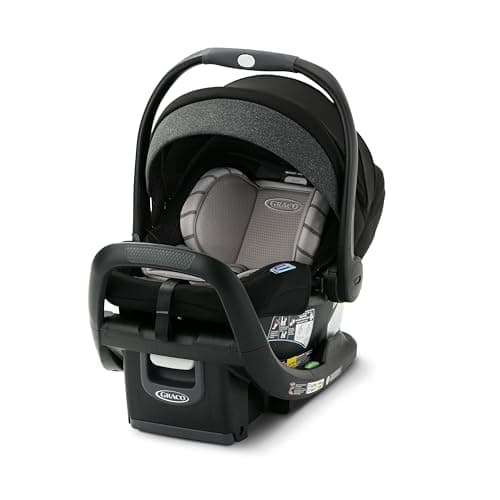
An infant seat that borrows the one piece of safety hardware budget carriers skip. Judged on Graco's published figures, a CPST-staffed fit database, and the federal rules that set the limits.
Disclosure:Swaddle & Stroll is reader-supported. When you buy through links on this page we may earn an affiliate commission, at no extra cost to you. It never changes our picks. How this works.
The Graco SnugRide SnugFit DLX earns its place for one structural reason: it comes with an anti-rebound bar, and almost nothing else at a mainstream infant-seat price does. Pair that with SnugLock — a belt lock-off that takes the guesswork out of a seat-belt install — and you have the two things that most often go wrong with a budget infant seat solved in the box. What you do not get is longevity. Graco publishes 4 to 30 pounds and up to 32 inches for this seat, which is exactly the same ceiling as carriers costing considerably less.
One disclosure first, in keeping with how we pick: we have not crash-tested this seat and we do not claim to have. What follows is built from Graco's own published specifications, the spec and fit entry maintained by Safe in the Seat (a CPST-staffed outlet), the retailer spec sheets that publish the component weights Graco does not, the live Amazon listing, and the federal rules that govern all of it. Where two sources disagree on a number, we print both and say which one to plan around.
First, the number you will see wrong everywhere
Search this seat and you will find two rear-facing limits quoted: 30 pounds and 35 pounds. Both are real, because there are two similarly named seats. Graco's published figure for the SnugRide SnugFit DLX is 4 to 30 pounds and up to 32 inches. The 35-pound figure belongs to the SnugRide SnugFit 35 DLX, whose own manual states 4 to 35 pounds and 32 inches or less. Retailers mix the two names constantly, and the listing photos look nearly identical.
This matters more than a naming quibble. A rear-facing weight limit is a hard stop, not a target, and the only figure that governs your seat is the one printed on the label on the side of the shelland in the manual in the box. Read it before you assume you have five extra pounds of carrier life. If you want the longer limit, buy the model with “35” in the name and confirm the label says 35 pounds.
We previously described this seat as reaching 35 pounds on several pages of this site. It does not, and we have corrected it everywhere it appeared.
The verified specifications
Spec
Published figure
Rear-facing
4–30 lb, up to 32 in, with the head at least 1 in below the top of the seat
Standard
FMVSS 213 certified; Graco markets the shell as ProtectPlus Engineered for frontal, side, rear and rollover crashes
Carrier weight
9.8 lb (retailer spec sheets)
Base weight
7.44 lb; carrier plus base is listed at 16–17 lb
Anti-rebound bar
Included as standard — limits rotation of the seat and child in an impact
Install
SnugLock base — vehicle seat belt or lower anchors, with a belt lock-off
Base recline
5 positions, with a level indicator
Harness
No-rethread, front-adjust
Aircraft
FAA approved (carrier, used without the base)
Useful life
Discard 7 years after the date of manufacture
Dimensions
Listed around 27.5 in L × 17.5 in W × 25.5 in H (retailer figures vary)
Warranty
1 year
The anti-rebound bar is the reason to buy this seat
An anti-rebound bar is a padded bar on the front of the base that rests against the vehicle seat back. In a frontal crash a rear-facing seat first rides down into the vehicle seat, then rebounds — rotates back up and toward the seat back. The bar gives that rebound something solid to meet instead of letting the shell swing freely.
It is not required for certification, and a seat without one is not unsafe. But it is a genuine piece of engineering rather than a marketing feature, and the reason it is worth noticing here is what it normally costs. Anti-rebound hardware and load legs are usually the dividing line between mainstream infant seats and the premium tier. Graco put one on a seat priced in the middle of the market, and that is the single clearest argument for this seat over a cheaper SnugRide.
The alternative solution to the same problem is a load leg — a strut from the base down to the vehicle floor. Premium seats use those instead, and we walk through the trade in Graco vs Nuna car seats. A load leg does more, needs floor clearance your vehicle may not have, and costs considerably more. The bar is the pragmatic version.
SnugLock, and why a lock-off matters more than it sounds
The most common infant-seat mistake is a loose install. The federal rule of thumb is less than one inch of movement at the belt path, and getting there with a vehicle seat belt means pulling all the slack out and then keeping it out while the retractor fights you.
SnugLock is Graco's answer: you route the belt, then close a lever that clamps it. The tension you set is the tension that stays. Graco states the base installs in under a minute with either the vehicle belt or the lower anchors, and the base carries a level indicator so the recline angle is not a judgment call either.
Two things to keep straight. First, lower anchors and the seat belt are alternatives, never both at once — our LATCH vs seat belt installation guide explains why and how to choose. Second, lower anchors carry a combined weight limit, so on a long-serving base the belt install is often the one that lasts. The infant car seat install walkthrough covers the inch test and the recline check step by step.
Who it fits, and the preemie caveat
The 4-pound floor is the official number, but a low minimum weight is not the same thing as a good newborn fit. What matters for a small baby is how low the bottom harness slot sits and how short the crotch-strap position is — straps have to come at or below the shoulders rear-facing, and a long crotch strap lets a tiny baby slump forward.
Safe in the Seat's entry for this seat flags exactly that: it advises caution if you are expecting a small baby, and says preemie fit may not work well. If you are being discharged with a baby under about 6 pounds, or you know you are having twins and expect lower birth weights, fit the seat to the baby before you commit to it— a hospital CPST check is free and worth more than any spec table. Our twin stroller guide gets into the same problem from the other direction.
At the top end, plan on height. Thirty-two inches arrives for most babies before 30 pounds does, and the rule is the head must stay at least an inch below the top of the shell. Our how long infant car seats last guide explains how to read that in practice, and infant vs convertible car seat covers what comes next — including rotating convertibles such as the Chicco Fit360, which starts at the same 4 pounds and skips the carrier stage entirely.
The honest cons
The 30 lb / 32 in ceiling is ordinary. This is the most important thing to understand before you buy. Cheaper SnugRide carriers reach the same 30 pounds and 32 inches. You are paying for the bar, the lock-off and the softgoods, not for extra months in the carrier.
It is a heavy carrier. At 9.8 pounds empty, the shell is noticeably heavier than the lightest infant seats, which sit nearer 6 to 7 pounds. Add a baby and you are lifting a serious weight in and out of a car ten times a day, often one-handed and twisted over a door sill. If that is your main constraint, this is not your seat.
The base takes up room.The anti-rebound bar adds front-to-back footprint, which is the cost of the feature. In a small car, or where you need three across, measure first — our small-car car seat roundup ranks by footprint rather than features.
No load leg. The bar addresses rebound; a load leg additionally braces the base against the floor. If you want both, you are in a higher price tier.
Preemie fit is a real question mark. Flagged by the CPST-staffed source above. Do not assume a 4-pound minimum means a 4-pound baby rides well.
The naming is a mess, and that is on Graco.“SnugFit DLX” and “SnugFit 35 DLX” are different seats with different limits, sold under near-identical listings. Check the label.
Who should buy it, and who should not
Buy the SnugRide SnugFit DLX if you want the most safety hardware available at a mainstream infant-seat price, you install with a vehicle belt and want the lock-off, and your baby is an average-size newborn. It is the sensible-money pick in our best infant car seats roundup for exactly those reasons, and Chicco KeyFit Max vs Graco SnugRide SnugFit DLX is the head-to-head worth reading before you commit.
Buy something else if carrier weight is your deciding factor, you are expecting a very small baby, or you are already planning to skip the infant-seat stage. Lighter carriers exist at the same price; a premium seat buys a load leg and a few pounds off the shell, which we lay out in Graco vs Chicco car seats. And if you are not sure the infant-seat route is right at all, how to choose a car seat starts from scratch.
An anti-rebound bar and Graco's SnugLock install at a mainstream price — the sensible-money infant seat that doesn't cut safety corners.
Rear-facing
4–30 lb, up to 32 in (the 35 lb figure belongs to the separately named SnugFit 35 DLX)
Standard
FMVSS 213 certified
Extra
Anti-rebound bar
Install
SnugLock (belt or LATCH), 5-position base recline
Carrier weight
9.8 lb (base 7.44 lb)
Useful life
7 years from date of manufacture
What we like
Anti-rebound bar adds crash stability — unusual at this price
SnugLock belt lock-off makes a tight install straightforward
Great price-to-feature ratio
FAA approved for aircraft use without the base
Worth noting
Bulky base footprint
Carrier is on the heavier side at 9.8 lb
30 lb / 32 in ceiling is no longer than much cheaper carriers
Safe in the Seat flags caution on preemie fit
How it scored
Safety-standard compliance9.4
Install ease9.0
Fit range9.0
Value9.2
Frequently asked questions
Does the Graco SnugRide SnugFit DLX rear-face to 30 or 35 pounds?+
Thirty. Graco publishes 4 to 30 lb and up to 32 in for the SnugRide SnugFit DLX. The 35 lb figure that circulates belongs to a separately named seat, the SnugRide SnugFit 35 DLX, whose manual states 4 to 35 lb. Retailers mix the two names, so the only figure that governs your seat is the one on the label on the shell and in the manual.
What does the anti-rebound bar on the SnugFit DLX actually do?+
It is a padded bar on the front of the base that rests against the vehicle seat back. In a frontal crash a rear-facing seat rebounds — rotates back toward the seat back — and the bar limits that rotation instead of letting the shell swing freely. It is not required for FMVSS 213 certification, but it is unusual at this price; anti-rebound hardware is normally a premium-tier feature.
Is the Graco SnugRide SnugFit DLX FAA approved for flying?+
Yes — the carrier is FAA approved for aircraft use without the base, which is how infant seats are used on a plane. Check the approval statement printed on your own seat's label before you travel, and see our travel car seat roundup for what makes a seat workable in an aircraft row.
How much does the SnugRide SnugFit DLX weigh?+
The carrier is listed at 9.8 lb and the base at 7.44 lb, with combined figures of 16 to 17 lb on retailer listings. That makes the carrier noticeably heavier than the lightest infant seats, which are nearer 6 to 7 lb — worth weighing if you will be lifting it in and out of a car many times a day.
Can you install the SnugFit DLX base with a seat belt instead of LATCH?+
Yes, and the SnugLock lock-off is designed for it: you route the vehicle belt, then close a lever that clamps it so the tension you set stays set. Use the lower anchors or the seat belt, never both at once. Either way the base should move less than an inch at the belt path.
When does the Graco SnugRide SnugFit DLX expire?+
Graco's guidance is to stop using it seven years after the date of manufacture, which is stamped on the seat. That date, not the purchase date, is what counts — which matters most for a hand-me-down seat.
Is the SnugFit DLX a good fit for a premature or very small baby?+
Treat it as an open question. The published minimum is 4 lb, but Safe in the Seat's entry for this seat advises caution if you are expecting a small baby and says preemie fit may not work well. If your baby is under about 6 lb at discharge, have the fit checked by a CPST before you rely on the seat.