There are two versions of this problem, and they need different answers. In the first, your back seat is simply narrow — a compact sedan, a hatchback, a small crossover — and one ordinary car seat leaves no usable space beside it. In the second, the row is wide enough but you need three restrained children across it, which turns every spare inch into a negotiation. What both versions have in common is that the seat you buy is judged on measurements almost no roundup bothers to print, so that is what this page is built on.
Before anything else, the safety part, because it is the part people get talked out of: every car seat legally sold in the United States is certified to the same federal crash standard, FMVSS 213. A narrow seat is not a compromised seat, and a $500 seat does not pass a harder test than a $150 one. What changes with price is how long the seat lasts, how easy it is to install tightly, and how comfortably it lives in your particular car. We have not crash-tested anything ourselves and we will not pretend otherwise; where a figure comes from an independent lab or a child passenger safety technician, we say whose it is. Our weighting is on the methodology page.
What we scored, and why
Every seat below was judged against the same five criteria, in this order of importance:
- Published width at the widest point. Not the marketing word "slim" — the number. It matters that this is measured at the widest point, because cup holders and flared armrests are usually what makes a seat too wide, and on several picks here they come off. Anything at or under about 17 inches is genuinely narrow; plenty of seats advertised as space-saving measure 19.
- Rear-facing footprint, front to back. This is the measurement small-car owners actually feel, and the one almost nobody publishes. A narrow seat that sits deep and reclined pushes the front passenger seat forward until nobody can sit in it. Width solves three-across; front-to-back decides whether an adult can still ride shotgun.
- Whether the shell is narrow all the way down. Three seats fit across a row when their bases clear each other and every buckle stays reachable. A seat with a wide flared base can measure 17 inches at the shoulders and still block the buckle beside it. Touching is fine; overlapping is not.
- How easy the belt install is. In a tight row, and especially in a center seating position, you will often be installing with the vehicle seat belt rather than the lower anchors — many vehicles do not allow borrowing anchors from the outboard positions, and every lower-anchor connector has a weight limit that ends well before the harness does. A belt lock-off is worth more here than in a big SUV.
- How many years the seat covers. A narrow seat you replace at three is more expensive than its price tag. Rear-facing weight limits and whether the seat converts to a booster do most of the work on this one.
Comfort, fabric, and fit-and-finish break ties. Brand prestige does not.
The one-minute answer
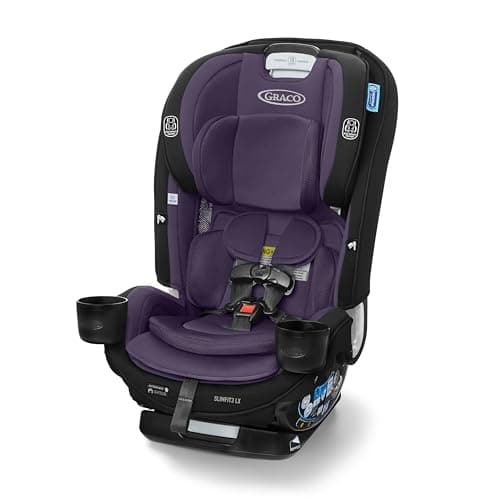
- You want one seat that solves a small back seat and you do not want to think about it: the Graco SlimFit3 LX 3-in-1.
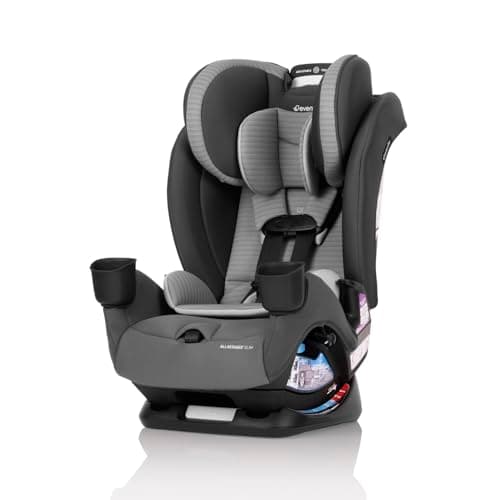
- You want the same idea for less money and more years: the Evenflo All4Stages Slim 4-in-1, which is 16.9 inches wide and runs to a 120 lb backless booster.
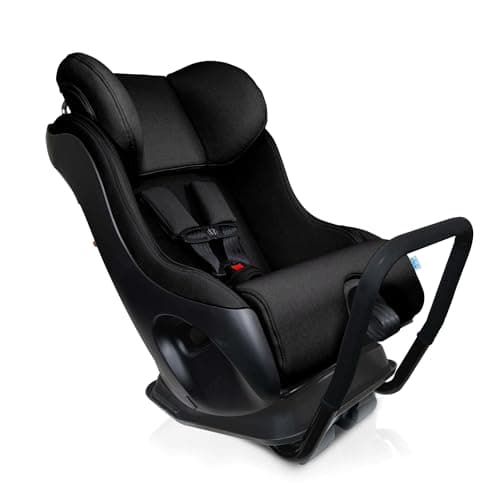
- You want to rear-face as long as possible in a narrow row: the Clek Fllo, rear-facing to 50 lb with a steel anti-rebound bar included.
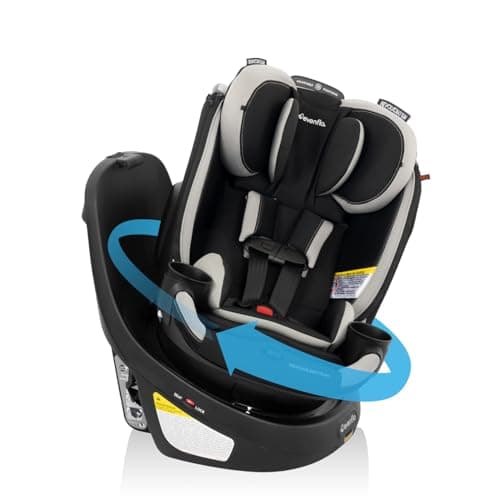
- Your back seat is so tight that loading the baby is the hard part: the Evenflo Revolve360 Slim, which rotates to face the door.
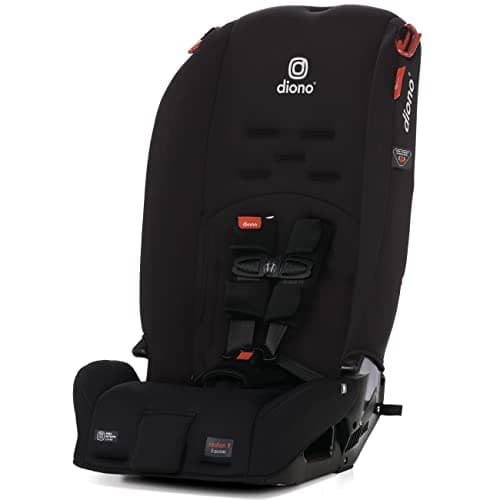
- You need three across and the budget is the constraint: the Diono Radian 3R — with the caveats below, which are real.
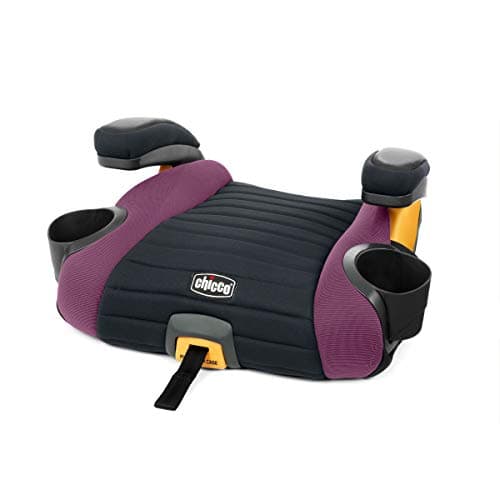
- The third child in the row is old enough for a booster: the Chicco GoFit Plus, at six pounds, is the cheapest inch you will ever buy back.
Narrow is only half the problem
The single most useful thing we can tell you is that width and depth are separate problems, and buying for one does not fix the other. The Diono Radian is the clearest example. It is 17 inches wide with flat steel sides, which is exactly what a three-across row wants — and Safe in the Seat's child passenger safety technicians point out that rear-facing it is very long front to back unless you also buy the Diono Angle Adjuster, a separate accessory that props the seat more upright. Buy the seat because the row is narrow, discover that the driver can no longer reach the pedals comfortably, and you have solved the wrong measurement.
Clek is one of the few manufacturers that publishes this number outright: the Fllo measures 32.5 inches front to back rear-facing with the anti-rebound bar fitted, and 29 inches without it. That single specification tells you more about whether a seat will work in a Civic than any amount of copy about slim design. Where a brand does not publish it, the next best evidence is a technician who installed the seat in a small car and said so — which is why Safe in the Seat's note that the Graco SlimFit3 LX "doesn't take up a lot of space in the rear-facing mode" carries weight in our ranking, and why Car Seats For The Littles' finding that the Fllo's deepest recline left the front seat unusable in a compact car is a con we list rather than bury.
The practical move: before you buy, measure from the back of your rear seat cushion to the back of the front seat where you normally set it. Then compare. Rear-facing seats are also more upright the heavier the child gets, so a seat that barely fits with a six-month-old usually gets easier, not harder — but it has to fit on day one.
Three across is a vehicle problem too
Adding up three widths and comparing the total to your bench is the right instinct and the wrong math. Whether three seats fit depends just as much on where your vehicle's buckles sit, whether they are on rigid stalks or floppy webbing, how much the seat back is contoured, and whether the center position has a lap-and-shoulder belt or a lap belt only. Two cars with identical rear bench widths regularly disagree about the same three seats.
A few rules that hold up across vehicles. Seats may touch each other, but no seat may sit on top of another or block a buckle you need to reach. The narrowest seat usually belongs in the middle, because that is where clearance is tightest and where you will be reaching in blind. Check your vehicle's owner manual before you assume you can use the lower anchors in the center position — many cars do not permit borrowing the inner anchors from the two outboard seats, which means a belt install, which means a seat with a good lock-off is worth paying for. And a backless booster for the oldest child, where they are genuinely ready for one, frees up more room than any amount of shopping for a narrower harnessed seat.
The picks, and who each one is for
Graco SlimFit3 LX 3-in-1 — best overall. Graco lists it at 16.7 inches wide; independent reviewers measure between 16.5 and 17 depending on whether the cup holders are on, and they come off. What lifts it above the other narrow seats is the second measurement: technician reviews consistently describe it as compact rear-facing, not just thin. It is a 3-in-1, so it runs rear-facing from 5 to 40 lb, forward-facing to 65, then a highback booster to 100. BabyGearLab crash-tested it, recorded lower g-force readings than much of the field, and gave it their narrow-seat award. The honest limits: the recline is not right for a newborn, so this is a second seat rather than a first one; the booster stage lasts about a year past the harness, so it is unlikely to be the last seat you buy; and the seat-belt install genuinely takes effort to tighten.
Evenflo All4Stages Slim 4-in-1 — best value. A 16.9-inch shell with four modes, running rear-facing from 4 to 40 lb, forward-facing to 65, highback booster to 100, and backless to 120. It also meets the updated federal side-impact standard for children under 40 lb, which Evenflo publishes. It is less refined than the seats above and below it and there is no one-dial tensioner, so a careful install is on you — but per year of use it is the cheapest way to make a narrow row work.
Clek Fllo — best for extended rear-facing. Rear-facing to 50 lb inside a shell Clek measures at 16.9 inches of seating width and describes as just under 17 at the widest point, with a base only about 13 inches across, which is what leaves the buckles beside it reachable. The steel anti-rebound bar is in the box and every fabric option is flame-retardant free and PFAS-free. It is also the most expensive seat here by a wide margin, it starts at 14 lb and sitting unassisted so it cannot replace an infant seat, and at the deepest recline required for the smallest children it takes up enough room that a compact car's front seat may be unusable.
Evenflo Revolve360 Slim 2-in-1 — best rotating seat that still fits. Rotating seats are usually the first thing crossed off a small-car list because they are wide. This one is 16.9 inches, which Evenflo bills as the slimmest rotating seat in America, and it rear-faces to 50 lb so the rotation stays useful for years rather than months. In a car where you cannot lean in far enough to buckle a squirming toddler, that is worth a lot. It is also the seat with the most caveats: two modes only with no booster stage, 28.2 lb installed in two pieces, no forward-facing recline, and BabyGearLab ranked it 17th of 21 convertibles specifically because the lower-anchor install is a struggle and does not work in every vehicle. Try before you commit if you can. One more thing you need before you buy this one: the Revolve360 Slim carries an open US recall (NHTSA 25C010, for headrest foam a child can pick at, on seats made December 2022 to December 2024) and a Transport Canada non-compliance notice, both remedied free by Evenflo. We lay the detail out in our best rotating car seats roundup, which is also where to look if width is not actually your binding constraint.
Diono Radian 3R — cheapest genuine three-across. The steel-framed 17-inch Radian is the seat that made three-across mainstream, it rear-faces to 50 lb, it folds to about 7 inches deep, and it is routinely the least expensive seat on this page. We rank it fifth rather than first for a reason we think you should weigh seriously: Safe in the Seat's technicians do not recommend it. Their objections are the front-to-back length rear-facing without the separately sold Angle Adjuster, the number of removable parts and conditional rules that make it easy to install slightly wrong, and the gap between the 120 lb figure on the box and the torso height at which most children actually outgrow it. If your constraint is money and the row is narrow, it still does the job — go in knowing what you are taking on.
Chicco GoFit Plus — best for the big kid in a full row. The cheapest way to win space in a three-across row is usually to stop buying harnessed seats for a child who no longer needs one. At 17 inches wide, six pounds, and 40 to 110 lb, the GoFit Plus is a backless booster with quick-release lower anchors so it does not slide around the bench when it is empty. It is not a step up from a harness, though — it is a step down in restraint, so only move a child to it once they have genuinely outgrown their harness and can sit properly against the belt for the whole ride. It also needs a vehicle head restraint behind the child, which rules out some center seats.
What we left out, and why
Three seats that come up constantly in this search did not make the page, and the reason is the same each time: we checked the published width and it was not narrow. The Graco Contender Slim is listed at 19 inches. The Safety 1st Ellaris, sold as a slim-fit design, is also listed at 19. The Evenflo Sonus 65 measures 18.5 inches wide. All three are perfectly legitimate car seats and all three meet the same federal standard as everything above — they simply are not the answer to this question, and a page that included them for the sake of a wider price range would be lying to you about an inch and a half.
We also left out infant seats. The rear-facing-only carrier stage is short, most infant seats fit most cars, and the base is what determines the footprint rather than the carrier — so the decision is different enough to belong on its own page. If you are shopping for a newborn first, start with our best infant car seats roundup and come back here when the convertible decision arrives.
Rear-facing longer without losing the front seat
The American Academy of Pediatrics recommends keeping a child rear-facing until they reach the highest weight or height their seat allows, and a small car is not a reason to cut that short. It does, however, change how you get there. Three of the seats on this page rear-face to 50 lb rather than 40, which is often two extra years, and two of them do it in a shell under 17 inches wide.
If the rear-facing seat is crowding the front passenger, the fixes in order are: check whether your seat allows a more upright recline for a child who can hold their head up — most do, and the manual states the angle rules; move the seat to the passenger side and slide that front seat forward, since the front passenger seat is usually the one you can afford to lose; and only then consider a different seat. What is not a fix is turning the child forward-facing early to buy legroom. We will not rank a seat higher for making that easy, and we are not going to suggest it here either.
Installing in a tight back seat
Two things go wrong more often in small cars than large ones. The first is the lower anchors. Every seat's lower-anchor connectors have a weight limit stated in its manual — the Clek Fllo, for example, allows lower anchors to 35 lb rear-facing and 40 lb forward-facing, after which you switch to the vehicle belt — and many vehicles prohibit borrowing the inner anchors for a center install. In a narrow row you will be doing belt installs sooner and more often, which is precisely why the forward-facing lock-off on the Graco is a feature we weighted rather than a footnote.
The second is the buckle stalk. In a three-across row, the seat next to a buckle can leave it technically reachable but practically impossible for one hand holding a toddler. Test this with the seats installed and a child-sized volunteer before you decide the configuration works, and if you can, get the installation checked — free inspection stations are listed by NHTSA and staffed by certified technicians who install these seats all day. A tightly installed cheaper seat beats a loosely installed expensive one every time, and that is the whole reason install ease sits so high in our scoring.
The other half of the small-car problem is the stroller. If you are shopping for a bundle rather than a seat on its own, our best travel systems for small cars applies the same thinking to travel systems — fold type, frame size, and the rear-facing footprint of the infant seat that comes in the box.