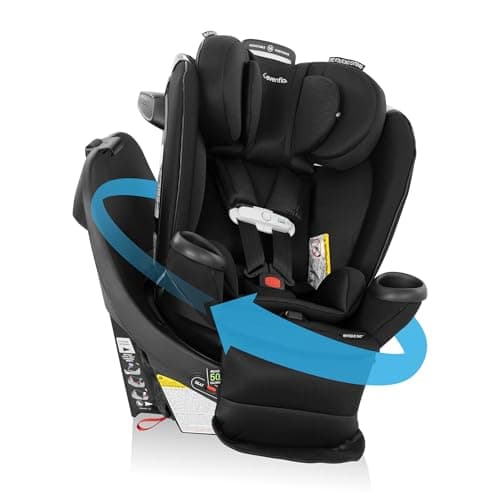
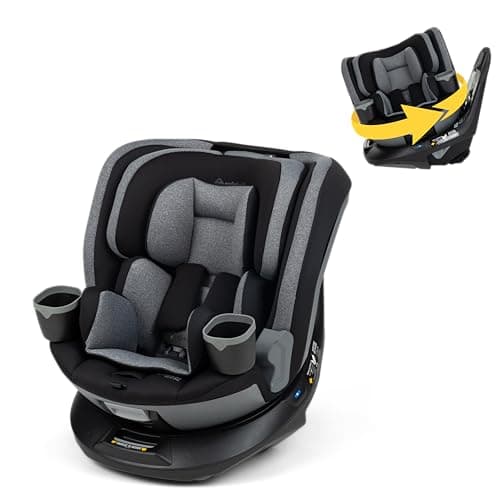
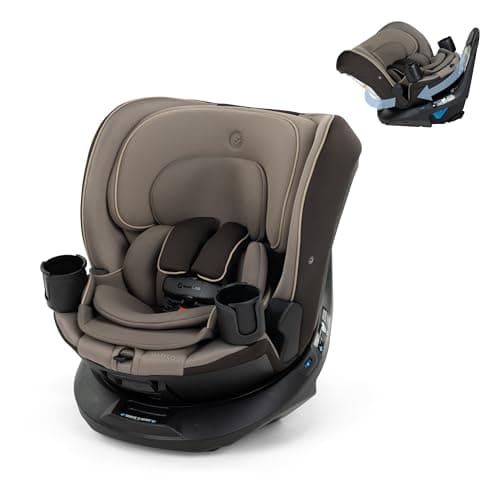
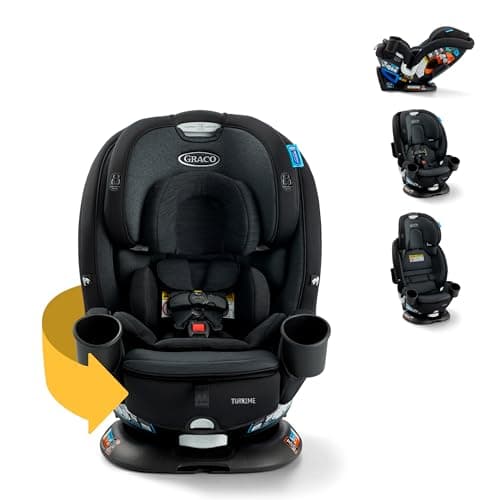
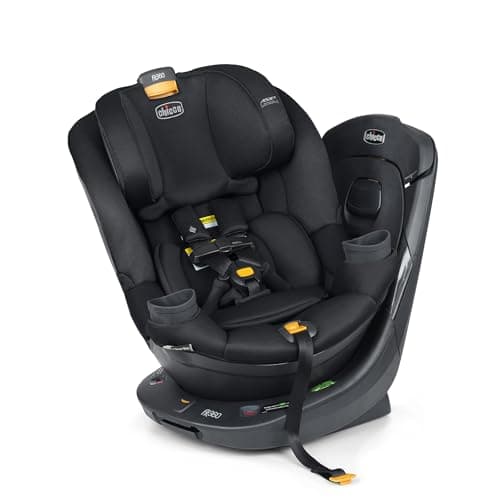
A rotating car seat spins on its base so you can turn the shell toward the open car door, sit your child down facing you, buckle the harness while standing more or less upright, and then turn the seat back until it locks. If you have ever folded yourself into a back seat to wrestle a squirming one-year-old into a rear-facing harness, you already understand the appeal. These seats are often sold as "360" or "swivel" seats, and they have gone from a niche European idea to a full shelf at every major brand in about three years.
Here is the honest framing we would want from a site before spending several hundred dollars. The rotation is a convenience feature, not a crash-safety feature. Every seat on this page is certified to FMVSS 213, the federal crash standard every car seat sold in the United States must pass, and a rotating seat is not safer in a crash than a good fixed convertible seat at half the price. What the rotation can do is change your behavior, and that is where the safety argument actually lives: a parent who can buckle a harness comfortably is a parent more likely to get it snug every single time, and more likely to keep a child rear-facing for the extra months the American Academy of Pediatrics asks for. That is a real benefit. It is also an indirect one, and we are not going to pretend otherwise.
The two seats at the top of this list are compared directly in Chicco Fit360 vs Evenflo Revolve360.
What we ranked on, and why
We have not crash-tested any of these seats, and we say so on every page. What we do is read the manuals and the published spec sheets, pull in the independent testing that does exist, and weight the criteria that separate seats which all clear the same federal bar. For rotating seats, four things decide whether the premium is worth paying:
- Which modes actually rotate.This is the single most misunderstood thing on the shelf, and the one we weight hardest. Several seats marketed with a big "360" on the box only rotate while rear-facing. That is not a scandal — the rear-facing years are when loading is hardest — but if you are buying the feature for a three-year-old, you need to know before you pay.
- Install ease. Rotating seats are heavy, two-piece, and install as a base plus a shell. A seat with a belt lock-off, a tension indicator, or a self-tensioning mechanism is far more likely to end up genuinely tight. Government checks keep finding that a large share of car seats are installed or used incorrectly, which is why we weight this above brand prestige.
- Published fit range. A rotating seat is expensive, so the years it covers matter. A rear-facing limit of 50 lb buys more rear-facing time than one of 40 lb. A booster mode means the rotation money is not spent on a seat you replace in two years.
- Honest value. Two seats on this page have identical published limits in all three modes, and one costs far more than the other. We will tell you that rather than let the more expensive one quietly look like the safer one.
The full weighting is on our methodology page. Scores are visible editorial judgments, never structured-data ratings.
The deadline nobody selling these seats mentions
If you are shopping in late 2026, there is a date worth knowing. NHTSA has added FMVSS 213a, the first federal side-impact crash test for harnessed seats rated to 40 lb, alongside FMVSS 213b, an updated frontal test bench. In a final rule published on May 30, 2025, the agency moved the compliance date for both from June 30, 2025 to December 5, 2026, after manufacturers warned of limited crash-lab sled time and a risk of seats disappearing from shelves. Any car seat manufactured on or after that date, for sale in the US, must meet the new side-impact requirements.
What that means practically: a seat bought today is legal, certified and fine to use for its full lifespan — this is not a recall and nothing on the shelf becomes unsafe on December 5. But if you are buying months ahead of a baby's arrival and you care about being on the newer standard, it is worth checking the date-of-manufacture sticker, or waiting. Chicco already publishes that the Fit360 meets or exceeds the frontal standard FMVSS 213b, and Maxi-Cosi states that the Andi 360 meets the federal side-impact standard. Most brands say nothing either way, which is itself a useful signal.
How to choose in one minute
- Want the rotation to work in both directions? The Chicco Fit360 ClearTex and the Maxi-Cosi Andi 360 both spin rear-facing and forward-facing. Most of this shelf does not.
- Want the longest rear-facing run? The Evenflo Gold Revolve360 Extend, at 4–50 lb rear-facing and 17–48 in, keeps a child rear-facing past the point where a 40 lb seat makes you turn them.
- Want a rotating seat for the least money? The Safety 1st Turn and Go 360 DLX. It was the cheapest rotating all-in-one we found in stock when we checked the shelf, and its red-to-green belt-tension indicators are a real install aid, not a sticker.
- Have a newborn arriving and a small back seat? Think twice about this whole category. The seats on this page run from roughly 18 to 20 inches wide and from 26 lb to over 40 lb. Our best car seats for small cars roundup ranks the narrow options on published width instead of the word "slim".
- Not sure you need the feature at all? A conventional convertible car seat does the same safety job for considerably less, and our rear-facing vs forward-facing guide covers the progression that actually matters.
The rotation lock-out, explained properly
It is worth being precise here, because the marketing is not. On the Graco Turn2Me, rotation is available rear-facing only. Car Seats for the Littles, whose reviews are written by certified child passenger safety technicians, states it flatly: the seat "rotates in rear facing mode. It does not rotate in forward facing mode." The Amazon listing title says the same thing, in small type, as "Rear-Facing Rotation Only." The Baby Jogger City Turn goes further and rotates only 180 degrees, again rear-facing only.
This is not a defect. Forward-facing children are easier to load anyway, and a seat that locks out rotation has one fewer moving part in the mode where a child can reach the mechanism. But it does change the value calculation: if your child is already two and a half, a rear-facing-only rotating seat will stop being a rotating seat quite soon. Buy the feature for the stage you are actually in.
Recalls and open safety notices on this shelf, checked October 2026
We check recall status before featuring any car seat, and we publish what we find even when it is inconvenient. As of this update:
- Evenflo REO by Revolve360 is under recall. Evenflo found that with the headrest in its two highest positions, it may change position under certain conditions. The notice covers only REO models whose number begins CS26021, and Evenflo states explicitly that it "does NOT affect any other Evenflo car seat, including the Revolve180, Revolve360, Revolve360 Extend, or Revolve360 Slim models." Our pick above is the Revolve360 Extend, which is not covered. Affected seats may keep being used in headrest positions 1–9 forward-facing and 1–10 rear-facing while a remedy is prepared.
- Evenflo Revolve360 Slim carries two separate notices, which is why it is not one of our picks here despite being the narrowest rotating seat sold. In the US, NHTSA recall 25C010 covers more than 324,000 Revolve360 Slim and Gold Revolve360 Slim seats made between December 1, 2022 and December 8, 2024: a child can reach under the headrest cover and pick off pieces of foam, and Evenflo logged 11 reports of children putting that foam in their mouth or nose. The remedy is a free tape seal and instructions. Separately, Transport Canada public notice 2025-P02 (July 23, 2025) covers 18,813 Revolve360 Slim seats made May 2023 to June 2025 that may not meet Canadian chest-acceleration requirements when installed rear-facing using the vehicle seat belt and tether. If you already own one, register it with Evenflo and request the remedy kit.
- Chicco Fit360, Graco Turn2Me, Safety 1st Turn and Go 360 DLX and Maxi-Cosi Andi 360: we found no recall covering these models at the time of this update. That is a snapshot, not a promise. Recalls are issued continuously, so check your own seat by model number and date of manufacture at our guide to checking car seat recalls, and register the seat with the manufacturer so they can reach you.
Three rotating seats we looked at and did not pick
Evenflo Revolve360 Slim is, on paper, the seat we wanted to recommend. At 16.9 inches wide it is the narrowest rotating seat on the US market, it rear-faces to 50 lb, and it has 15 harness heights. The two open notices above are the reason it is not a pick on this page. It remains covered on our small-car roundup, where its width is the decisive feature, and the notices are the first thing you should resolve if you buy one.
Baby Jogger City Turn is lighter than most of this shelf at 28 lb and rear-faces to 50 lb, but its patented turn is 180 degrees rather than 360, works rear-facing only, and it has no booster mode — so it ends at 65 lb forward-facing. At the price it asks, that is a narrower proposition than it looks.
Graco EasyTurn 360 is the cheaper two-mode sibling of our Turn2Me pick and does rotate a full 360 degrees. We left it off for one reason, and it is a big one: Graco publishes a rear-facing height limit of 32 inches. Many children pass 32 inches tall around 18 months to two years, well before they reach the 40 lb weight limit, which means the seat can force a forward-facing switch earlier than its weight limit suggests. If rear-facing longevity matters to you, that number should decide it. We also considered the Cybex Callisto G 360, which rotates and is genuinely premium, but stock was down to single units when we checked and we do not feature seats you may not be able to buy.
The mistakes that undo a rotating seat
Three come up repeatedly. The first is treating the rotation as the install. The seat still has to be locked tightly to the vehicle, rear-facing still needs the correct recline angle, and the top tether still matters forward-facing. A rotating seat that swings freely because the base is loose is worse than a cheap seat installed properly. Read your seat's manual alongside your vehicle's manual — the two together, not one or the other.
The second is the lower-anchor weight limit. Federal labeling caps lower-anchor use at a combined 65 lb of child plus seat, which is why manufacturers print a lower weight ceiling for the anchors than for the seat. Rotating seats are heavy, so they hit that ceiling early: the Turn2Me's lower-anchor limit is 35 lb rear-facing and 40 lb forward-facing, and the Fit360's is 30 lb rear-facing and 35 lb forward-facing. Past those numbers you switch to a vehicle-belt install. Our LATCH vs seat belt guide walks through the switch.
The third is turning a child forward-facing because the seat makes it easy. It is the whole hazard of a seat that spins both ways. Federal labeling now restricts forward-facing harness use to children of at least 26.5 lb, and the AAP asks for rear-facing until the child reaches the highest weight or height the seat allows — which on the Revolve360 Extend means 50 lb, not 26.5. The rotation should buy you more rear-facing months, not fewer. The quick-picks table below shows a live price for each seat and links straight to its full write-up, honest drawbacks included.