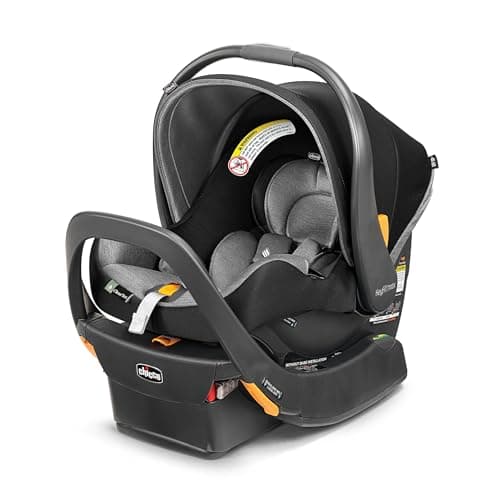
The Chicco KeyFit Max ClearTex is the seat that sits at the top of our best infant car seats roundup, and it carries a name that has been the default recommendation in American baby stores for well over a decade. The Max is the newest and tallest seat in that line: Chicco added an integrated anti-rebound bar, a five-position no-rethread headrest, and a taller shell that takes a child to 32 inches instead of the 30 inches the older KeyFits allow. It has earned a full review of its own. One thing first, in keeping with how we pick: we have not crash-tested this seat, and we do not pretend to have. What follows is built from Chicco's published specifications, the current Amazon listing, the independent sled-test results BabyGearLab publishes, notes from car-seat technicians, and the federal standards we cite on every car-seat page.
The short verdict
Buy the KeyFit Max if you want the easiest possible everyday routine: leave the base buckled in, click the carrier in and out, and use the two bubble levels and the spring-loaded leveling foot to get the recline angle right without guessing. It is a narrow seat by class standards, it is FAA certified for flying, the fabric skips added flame retardants, and the base fits the older KeyFit carriers if your family already owns one. Look elsewhereif you plan to install it with the vehicle seat belt rather than the lower anchors, if you need a carrier you can lift one-handed a dozen times a day, or if you want the longest possible rear-facing run out of an infant seat — 30 pounds and 32 inches is a mid-pack ceiling, and seats such as the Graco SnugRide SnugFit DLX go to 35 pounds. It is a good seat with two honest weaknesses: a belt install that independent testers rate poorly, and a carrier that is heavier than the spec sheet suggests.
What we judged it on
Every infant car seat sold in the United States must pass the same federal crash standard, so the question is never "is this seat safe." The question is whether it is the seat you are least likely to use wrongly, and whether it fits your baby and your car. We scored the KeyFit Max on four things, in this order: how hard it is to get a tight install at the correct recline angle; how long a real child can stay rear-facing in it; how heavy and awkward the carrier is in daily use, because a seat you dread carrying is a seat you end up using carelessly; and what you pay for all of it. Independent crash data, where it exists, informs the first criterion but is attributed by name rather than claimed as ours.
The numbers Chicco publishes
Chicco rates the KeyFit Max ClearTex for rear-facing use from 4 to 30 pounds and up to 32 inchesof standing height, with the usual requirement that the child's head stays at least an inch below the top of the headrest. The carrier is listed at 10 pounds and the stay-in-car base at 8.5 pounds, for 18.5 pounds assembled. The harness is a five-position, no-rethread Easy-Extend system that raises with the headrest; Chicco publishes a maximum harness slot height of 10 inches and a single crotch-strap position. The base gives six recline positions, set with a one-hand spring-loaded leveling foot and read off two liquid bubble level indicators. Lower-anchor installs use Chicco's SuperCinch force-multiplying tightener; belt installs use a steel-reinforced LockSure lock-off. An integrated anti-rebound bar is standard. The shell is lined with EPS energy-absorbing foam, the canopy is full-coverage and UPF 50+, and the fabric is Chicco's ClearTex — flame-retardant-free and GREENGUARD Gold certified for low chemical emissions. The seat is FAA certified for aircraft use, and the covers are machine washable on a cold delicate cycle. Chicco states that it meets FMVSS 213b for frontal impact, FMVSS 213a for side impact, and the 16 CFR Part 1225 / ASTM F2050 standard that applies to hand-held infant carriers.
Installing it: where the KeyFit reputation comes from
The KeyFit line earned its following on one thing, and it is still the best argument for this seat. With the base left buckled into the car, the routine is short: set the recline with the leveling foot, check the two bubble levels, hook the lower anchors, and pull the SuperCinch strap once. The tightener multiplies the force you apply, which is the difference between a base that shifts an inch at the belt path and one that does not. A loose base and a wrong recline angle are the two mistakes safety agencies find most often in real cars, and this base is built specifically to make both of them harder. Two level indicators rather than one also means you can read the angle from either side of the vehicle, which matters more than it sounds like when the seat is behind the driver and you are crouched in a parking lot.
The carrier itself clicks in and out with an intuitive release, and it clicks straight onto every current Chicco stroller except the Liteway and the Urbino — the basis of the matched travel systems Chicco sells. If your family already owns an older KeyFit, the Max base is reported to accept the original KeyFit, KeyFit 30 and KeyFit 35 carriers, though the compatibility runs one way: a KeyFit 35 carrier does not belong on an older KeyFit 30 base, and the Max is not compatible with the Chicco Fit2. Check your own manual before mixing generations, because a base and a carrier are certified as a system.
What independent testing found, including the part that stings
We do not run crash sleds, so we read the people who do. BabyGearLab, which buys seats and tests them on an instrumented sled, scored the KeyFit Max ClearTex 66 out of 100 in a January 2026 review, ranking it eighth of the fifteen infant seats in that group. The breakdown is more useful than the total: 6.9 out of 10 for crash testing, 6.5 for installing with lower anchors, 4.0 for installing with the vehicle seat belt, 6.5 without the base, 7.7 for ease of use, 7.7 for comfort and quality, and 6.1 for weight and size. Their testers liked the padding under the chest clip, the five headrest slots and the carrier release; they disliked the canopy colliding with the handle, the single crotch-strap position, and a belt lock-off they described as loose. They also noted that the older, cheaper KeyFit 30 recorded slightly better crash-sensor numbers and was easier to install.
That is not the result the KeyFit reputation leads you to expect, and we are not going to smooth it over. Read it carefully, though, because the shape of the finding matters. The seat scores respectably where most families actually live — lower anchors, base left in the car — and poorly on the belt install, which is what you fall back on in a taxi, a rental, a grandparent's car, or once your child plus the seat exceeds the lower-anchor weight limit. If that describes your life, the belt install is the number to weigh, and a seat with a clamping lock-off you can crank down may serve you better. If you will use the base with lower anchors nearly all the time, the weakness costs you much less.
Standards, side impact, and what "safer" really means
A crash score of 6.9 is not a safety verdict. Every seat in that test group, including this one, is certified to FMVSS 213, the federal standard every child restraint sold in the United States must meet; a seat cannot be sold here without passing it. Chicco additionally states compliance with FMVSS 213a, the side-impact standard that applies to restraints rated for children up to 40 pounds and 43 inches. Independent sled data describes differences between seats that all clear the same federal bar, and those differences are consistently smaller than the difference between a seat installed tightly and a seat installed loose. The single most valuable thing you can do for your child is not to buy a higher-scoring seat; it is to get a snug install at the right angle and keep them rear-facing to the limit, which is what the American Academy of Pediatrics recommends. Our car seat safety checklist walks the five-minute version of that check.
Fit: how long a real baby stays in it
Height, not weight, is what usually ends an infant seat. The Max's 32-inch ceiling is the practical improvement over the rest of the KeyFit family, which stops at 30 inches, and the anti-rebound bar buys some extra legroom by holding the shell away from the vehicle seat back. Independent reviewers describe the five headrest positions as covering roughly 6.5 to 13 inches of harness height, which is a genuinely newborn-friendly bottom setting — the removable newborn positioner is there for the same reason. Against the wider market, though, 30 pounds and 32 inches is the middle of the pack rather than the top: the Graco SnugRide SnugFit DLX runs to 35 pounds, as we lay out in our KeyFit Max versus SnugRide SnugFit DLX comparison. Most babies reach an infant seat's height limit somewhere between nine and eighteen months either way, and then you move to a convertible seat and keep riding rear-facing. Buying the seat with the higher ceiling rarely buys as many extra months as the number implies.
Living with it
The carrier is where the Max asks something of you. Chicco publishes 10 pounds; The Car Seat Pros weighed 10.6 and BabyGearLab measured 11.1. Whichever figure you trust, it is a heavier carrier than the lightest seats in the class — the Evenflo LiteMax sits several pounds under it — and you feel the difference by the tenth lift of the day, especially carried on one forearm with a baby in it. That weight buys a solid, well-padded shell, but if your daily pattern is car to stroller to store and back, weigh it honestly; our KeyFit Max versus Evenflo LiteMax comparison is the head-to-head on exactly that trade-off.
Two smaller irritations show up consistently in hands-on reviews. The canopy fouls the handle at some positions, and it takes two hands to extend rather than one. And the baseless, European-style belt route is fiddly: the padding is thick enough that testers describe having to floss the lap belt under the guides. Neither is a safety problem. Both are the sort of thing you notice every single day, which is why they belong in a review rather than on a spec sheet. On the credit side, the width is a genuine advantage — about 16.5 inches at the shell, narrow enough that technicians list it as a candidate for three across and for small back seats, which is the same reason it appears in our best car seats for small cars work.
Where it sits in Chicco's own lineup
Chicco sells several KeyFit variants alongside the Max, and the ladder is worth understanding before you pay for the top of it. The plain KeyFit and KeyFit ClearTex stop at 22 pounds and 30 inches with a 9-pound carrier. The KeyFit 30 ClearTex reaches 30 pounds but still stops at 30 inches. The Max adds the extra two inches of height, the anti-rebound bar and the no-rethread harness, at the highest list price of the three. Above it, the KeyFit Max Zip ClearTex and Max Zip ClearLux add a zip-out boot and a magnetic privacy panel to the same shell and the same limits, for meaningfully more money — comfort features, not safety ones. In plain terms: the Max is the KeyFit to buy if you want the tallest shell and the rebound bar, the KeyFit 30 ClearTex is the value play in the family, and the Zip models are a weather-and-convenience upgrade you can skip without giving up any protection. The live price for the Max is shown on this page and refreshes daily; it moves often enough that it is worth checking rather than remembering.
Recalls, registration, and how long it lasts
Chicco rates the KeyFit Max for six years from its date of manufacture, which is printed on the shell — shorter than the ten years an all-in-one seat gets, and a reason to be careful with hand-me-downs. As of this review, the only active recall listed on Chicco's own recall page is for the MyFit Zip Air harness-and-booster seat, models 07079561970070 and 04079561190070, manufactured between September 2020 and August 2024; no KeyFit or KeyFit Max appears on it. Register your seat with Chicco when it arrives so you are contacted directly if that ever changes, and see our guide on how to check for car seat recalls if you are buying secondhand. Any seat that has been in a crash, has an unknown history, or shows cracked plastic or frayed webbing should be replaced regardless of its date.
The verdict
The KeyFit Max is a good infant seat that is easy to live with in the way most families actually use an infant seat: base in the car, carrier clicking in and out, the recline angle sorted by a leveling foot and two bubbles rather than by a rolled towel and hope. The anti-rebound bar, the narrow shell, the flame-retardant-free fabric and the FAA certification are all real, verifiable advantages, and the six recline positions make it friendlier than most to an awkwardly angled back seat. What it is not is the class leader on paper. It stops at 30 pounds and 32 inches when rivals go further, the carrier is heavy, and the seat-belt install is the weakest part of an otherwise strong design. If you install with lower anchors and want the fewest chances to get it wrong, this is a seat we are happy to have at the top of our infant-seat list. If you will be moving it between cars on the vehicle belt, read the SnugRide comparison before you decide.