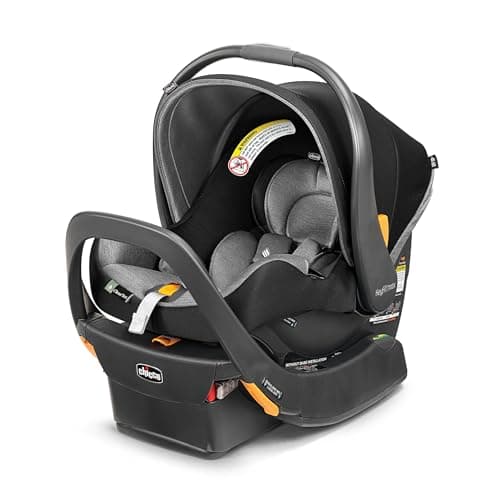
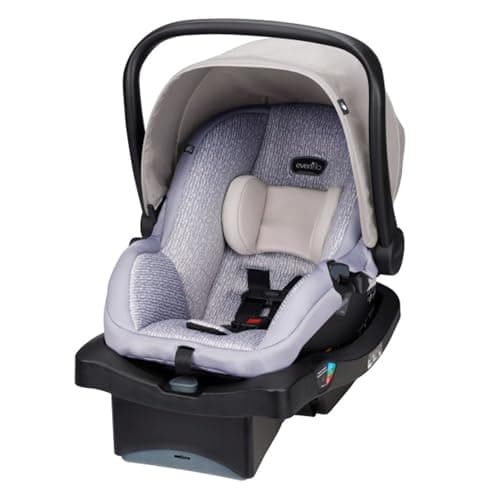
First, the most important thing: both of these seats meet FMVSS 213, the same federal crash-protection standard every infant car seat sold in the US must pass. Neither is "safer" on paper. What separates them is how easy each is to install tightly, how heavy the carrier is to lug, the fabric, and the price — and since a correct, tight install is what actually protects your baby, ease of installation is a genuine safety feature, not just a convenience.
Quick verdict: pick the Chicco KeyFit Maxif you want the most foolproof, tight install and don't mind a heavier, pricier carrier; pick the Evenflo LiteMaxif you want the lightest possible carrier to haul in and out of the car, at a much lower price. We haven't crash-tested either — that's the government's job — so this leans on published specs and our methodology, the rubric behind our best infant car seats roundup.
Installation
This is the KeyFit's claim to fame. It uses a bubble level to get the recline angle right and a single-pull LATCH tightener that makes a rock-solid install genuinely easy to achieve — the reason it's a perennial favorite of car-seat techs. The LiteMax installs with belt or LATCH and a level indicator, and it installs fine, but it doesn't have quite the same idiot-proof reputation. Because a large share of car seats are installed too loosely, the KeyFit's edge here is meaningful for anyone not fully confident doing it themselves. If you go with either, get the install checked — many fire stations and hospitals will inspect it free.
Weight and daily carrying
Here the LiteMax wins outright. At around 6 pounds it's one of the lightest infant carriers made, which matters a lot when you're lifting the seat plus a growing baby a dozen times a day. The KeyFit Max is a heavier carrier — sturdy and well-padded, but you feel it on your arm. If you'll carry the seat in and out constantly rather than leaving a base in one car, the LiteMax's low weight is the feature you'll appreciate most.
Fabric, padding, and rear-facing limits
Both seats rear-face for roughly 4 to 30 pounds, so the useful window is similar — and with either, most babies reach the heightlimit before the weight limit, at which point you move to a convertible seat. The KeyFit Max uses Chicco's ClearTex fabric, made without added flame-retardant chemicals, and is more generously padded. The LiteMax is more minimally padded, part of how it stays so light and cheap. If FR-free fabric and plush padding matter to you, the KeyFit leads; if you prioritize low weight and low price, the LiteMax's simpler build is the trade you're making on purpose.
Value
The LiteMax is the budget choice by a clear margin, and it's an honest one — a light, FMVSS-213-certified seat that does the core job for less. The KeyFit Max costs more and gives you the easiest install, nicer fabric, and more padding. Neither is a mistake: you're choosing between foolproof-and-premium and light-and-affordable. Check the live prices on the cards below, since sales move them.
Who each is for
Choose the Chicco KeyFit Max if a tight, easy install and premium comfort top your list. Choose the Evenflo LiteMaxif a light carrier and a low price matter more. Either way, remember both seats are outgrown within the first year or so — our guide on how long infant car seats last and when to switch to a convertible cover what comes next. Live prices and specs are in the cards below.