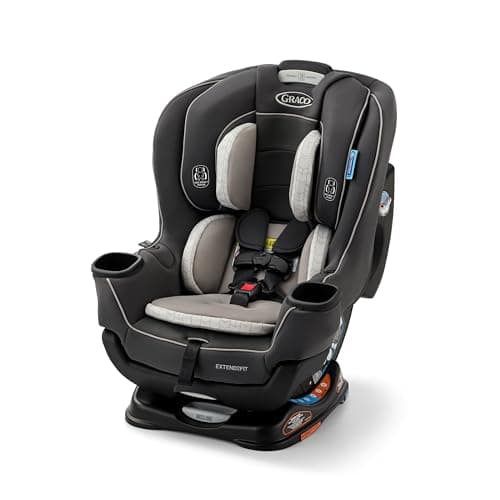
Graco Extend2Fit Review: The Cheapest Way to Rear-Face Longer
A mid-market convertible seat built around one idea — more legroom, so rear-facing lasts to 50 pounds. Judged on Graco's published figures, a CPST teardown, and the federal rules that govern both.
Disclosure:Swaddle & Stroll is reader-supported. When you buy through links on this page we may earn an affiliate commission, at no extra cost to you. It never changes our picks. How this works.
The Graco Extend2Fit does one thing better than almost anything near its price: it keeps a child rear-facing to 50 pounds, which is the single highest-value safety decision available to a parent buying a car seat. The four-position extension panel adds up to five inches of legroom, which is how a toddler with long legs stays rear-facing instead of being turned around early for comfort. The cost of that is space: with the panel out, this is a bulky seat front-to-back, and in a small car it will cost the front passenger real legroom.
Per how we pick: we are not a crash-test lab and we do not claim to be. What follows is built from Graco's published specifications, the hands-on measurements published by Car Seats For The Littles — a CPST-run outlet that physically measures harness heights and shell dimensions — the current Amazon listing, and the federal rules that set the limits both of them quote. Where Graco and CSFTL disagree on a number, we print both and explain why they differ.
The verified specifications
Spec
Published figure
Rear-facing
4–50 lb, until the child's head is at least 1 in below the headrest adjuster handle at full extension
Forward-facing
26.5–65 lb (Graco), up to 49 in tall; CSFTL's review of the seat lists 22–65 lb — see below
Lower-anchor (LATCH) limit
45 lb child weight (CSFTL) — lower than the harness limit
Extension panel
Adds up to 5 in of legroom; Graco markets 4 positions, CSFTL counts 3 usable positions plus stowed
Harness slot heights
7 in lowest (with the insert) to 17.5 in highest (CSFTL)
Headrest / harness
10 positions, no-rethread Simply Safe Adjust — headrest and harness move together
Recline
6 positions. Rear-facing uses 1–4; forward-facing uses 4 under 40 lb, or 5–6 over 40 lb
Seat weight
18.5 lb (CSFTL)
Width / height
20 in at the cupholders; 30 in shell height with the headrest fully extended; 27 in seated height (CSFTL). Graco publishes 21.5 in depth and 23.5 in height
Useful life
10 years from the date on the seat's sticker
Modes
Two — rear-facing harness and forward-facing harness. The 2-in-1 is not a booster
The 22 vs 26.5 pound confusion, explained
You will find both numbers quoted as the Extend2Fit's forward-facing minimum, and both are correct for different production dates. In December 2023 NHTSA finalized a change to FMVSS 213 labeling that requires forward-facing harness use to be labeled for children of at least 12 kg — 26.5 lb — rather than the older 22 lb floor. The compliance date was subsequently moved to December 5, 2026, so seats in the pipeline carry one label or the other depending on when they were built.
What to do about it:read your own seat's label and manual, which are the only authority for your specific seat. And note that this is a floor, not a recommendation — the reason to care about it is that it tells you nothing about when to turn a child around. On a seat that rear-faces to 50 lb, the forward-facing minimum is close to irrelevant, because you should not be anywhere near it. Rear-facing vs forward-facing covers the decision properly, and when to switch to a convertible car seat covers the move before this one.
The lower-anchor limit nobody mentions
This is the practical detail most reviews skip. The Extend2Fit's harness goes to 65 lb, but CSFTL lists the lower-anchor weight limit at 45 lb. That is not a defect; it is federal arithmetic. Since a 2014 NHTSA rule, lower anchors are labeled so that the child plus the seat does not exceed 65 lb combined. At 18.5 lb, this seat uses up 18.5 of that 65, which leaves roughly 46 lb of child — hence the 45 lb figure.
The consequence: at some point you must switch from LATCH to the vehicle seat belt, and that point arrives well before the harness limit. A belt installation is every bit as safe as LATCH when done correctly — our LATCH vs seat belt installation guide walks through both — but it is a step many families do not know is coming.
Living with the extension panel
The panel is the product, so it is worth being precise about it. It slides out from under the seat to support the child's lower legs, adding up to five inches. Graco markets four positions; CSFTL counts three usable positions plus fully stowed, which is the same hardware described two ways. It squeezes to release, and — importantly — it can only be adjusted with the seat uninstalled. Set it before you tighten the install, not after.
One manual quirk CSFTL flagged and asked Graco to clarify: the instructions call for the panel to be in positions 2–4 for children over 40 lb. Graco told them that leaving it stowed is not misuse. If your seat is near that weight, follow your manual.
The space cost is real and it is the main reason not to buy this seat. Stowed and fully upright, CSFTL found it compact enough to leave room for a tall front passenger. Extended, it takes up noticeably more front-to-back space. If your car is small, read best car seats for small cars before you order this one — there are narrower, shallower seats designed for exactly that problem.
Two install details worth knowing before you buy
The recline indicator is weight-dependent, and for a newborn it is strict. Rear-facing uses recline positions 1 to 4, but CSFTL notes that a child under three months must be installed within the light blue range of the recline indicator — the more reclined end — because a newborn cannot hold their own head up and a seat that is too upright lets the chin drop to the chest. Forward-facing then uses position 4 under 40 lb, and 5 or 6 above it. These are not comfort preferences; they are the manual's instructions, and they change as the child grows.
You are allowed more overhang than you probably think.A common worry with a deep rear-facing seat is that its base hangs off the front of the vehicle seat cushion. Graco permits up to 20% of the seat's front-to-back length to overhang, and CSFTL notes the base carries labels showing where that limit falls, so you can check it rather than guess. That often rescues an install in a car with short cushions — worth knowing before you conclude the seat does not fit. If you are fitting this alongside two other seats, read our installation walkthrough first; the 20-inch cupholder width is the number that decides a three-across.
The honest cons
Bulky front-to-back with the panel out.The feature you bought it for is the feature that eats your passenger's legroom. In a compact car with a tall driver, this can be a dealbreaker.
The rear-facing belt path is tight. CSFTL found the rear-facing vehicle belt path smaller than typical, which makes threading a belt harder, and noted that in some vehicles you have to pull the cover aside to finish tightening the lower anchors. Forward-facing belt installation was easier than rear-facing.
LATCH runs out at 45 lb.Plan on learning the belt install — see above.
Both cupholders must be attached before use. A small thing, but it adds width you cannot opt out of, which matters if you are fitting three across.
Fiddly cover details.CSFTL noted the headrest flap can catch under the cover when you adjust it, and wanted easier cover removal around the rear-facing belt path — relevant the first time you need to deal with a car-sickness incident. Our guide to cleaning a car seat safely covers what you may and may not do to the harness.
It is not a booster.The 2-in-1 ends at the forward-facing harness, so there is a third seat to buy later. If you would rather buy once, the all-in-one route is the comparison to read — Graco 4Ever vs Extend2Fit sets the two side by side.
Ten years, from manufacture. Useful if you are buying new for a first baby and planning to reuse it; something to check carefully if you are handed one down. Car seat expiration dates explained covers where to find the sticker.
Who should buy it, and who should not
Buy the Extend2Fit ifextended rear-facing is your priority and your car has the depth for it. Nothing else at this price pairs a 50 lb rear-facing limit with the legroom to actually reach it, which is why it is our extended-rear-facing pick in best convertible car seats.
Buy something else if front-seat legroom is tight, or you want one seat for the whole run. For the small-car problem, start with best car seats for small cars. For easier loading without bending into the car, a rotating seat solves a different daily pain — Chicco Fit360 vs Graco Extend2Fit is that trade exactly. And Extend2Fit vs Evenflo All4Stages is the head-to-head against the obvious budget alternative. Whatever you buy, install it using the car seat safety checklist and register it so recall notices reach you.
A four-position extension panel adds up to five inches of legroom, letting most children stay rear-facing to 50 lb — the safest riding position, kept longer.
Rear-facing
4–50 lb
Forward-facing
26.5–65 lb
Standard
FMVSS 213 certified
Extra
4-position extension leg panel
What we like
Rear-facing all the way to 50 lb
Extension panel buys real legroom
Strong value
Worth noting
Takes up a lot of front-to-back space rear-facing
Heavier seat
How it scored
Safety-standard compliance9.6
Install ease8.8
Longevity9.0
Value9.2
Frequently asked questions
How long can a child stay rear-facing in the Graco Extend2Fit?+
To 50 lb, or until the child's head is less than 1 inch below the headrest adjuster handle at full extension — whichever comes first. The four-position extension panel adds up to 5 inches of legroom, which is what makes the 50 lb limit usable rather than theoretical for a long-legged toddler.
Why do some sites say the Extend2Fit forward-faces from 22 lb and others say 26.5 lb?+
Both are right for different production dates. A December 2023 NHTSA final rule changed FMVSS 213 labeling so forward-facing harness use is labeled from at least 12 kg (26.5 lb) rather than the older 22 lb floor, with the compliance date later moved to December 5, 2026. Read your own seat's label and manual — and note it is a minimum, not a recommendation.
What is the LATCH weight limit on the Graco Extend2Fit?+
CSFTL lists a 45 lb lower-anchor limit, well below the 65 lb harness limit. That follows a 2014 NHTSA rule under which lower anchors are labeled so child plus seat does not exceed 65 lb combined; the seat itself weighs 18.5 lb. Past that point you install with the vehicle seat belt instead, which is equally safe when done correctly.
How much does the Graco Extend2Fit weigh?+
18.5 lb according to CSFTL's hands-on review. It measures 20 inches across at the cupholders and 30 inches of shell height with the headrest fully extended; Graco publishes 21.5 inches of depth and 23.5 inches of height.
When does the Graco Extend2Fit expire?+
Ten years from the date printed on the sticker on the seat, not ten years from the date you bought it. The sticker is usually on the bottom or back of the shell, and the manual is the authority for your specific seat.
Does the Extend2Fit turn into a booster?+
The 2-in-1 version does not — it covers rear-facing harness and forward-facing harness only, so a booster is a later purchase. Graco sells 3-in-1 and all-in-one Extend2Fit variants that do include booster modes, with different specs; check which version a listing is selling before you buy.
Will the Extend2Fit fit in a small car?+
Stowed and fully upright it is reasonably compact, but with the extension panel out it takes noticeably more front-to-back space and will cost a front passenger legroom. If your car is small, compare it against seats designed for shallow back seats before committing.