Quick verdict: the honest answer is that these two devices are not really rivals — they measure different things. Choose the Owlet Dream Sockif you want a wearable that reads your baby's pulse rate and oxygen trends and nudges your phone when they drift outside preset zones; choose the Nanit Pro if you want to actually see your baby from anywhere, with a clear overhead camera and sleep analytics layered on top. If your nights feel anxious because you cannot tell what is happening in the crib, the sock speaks to that; if they feel anxious because you cannot see the crib, the camera speaks to that. Plenty of parents end up wanting both, and that is a completely reasonable place to land.
A quick word on how we reach a verdict here: we rank from each product's published specifications and our own scoring method, not from a hands-on lab test where we wire up sensors and measure accuracy ourselves, so we are careful to describe what each device is designed to do rather than promise precision numbers we have not verified. You can see exactly how we weigh features, reliability, reassurance, and value in our methodology. With that said, the core split is easy to state: the Owlet senses movement and wellness readings at the baby, while the Nanit gives you video and sleep insight from above the crib.
What each one actually tracks
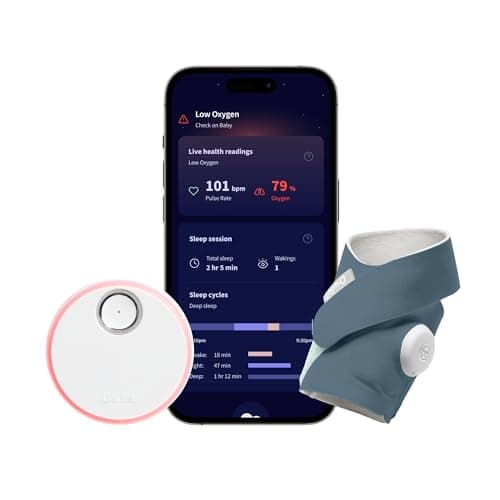
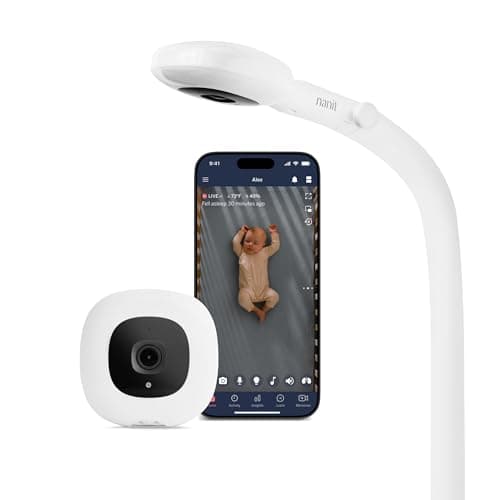
The Dream Sock is a wearable. It slips a soft, washable sock onto your baby's foot, and the sensor inside reports pulse rate and oxygen trends to a base station and to the Owlet app. When the readings move outside the comfort zones Owlet has set, the base station chimes and your phone gets a notification. That is its whole reason to exist: it is a contact device that tells you something about the baby's body, not the room. The Nanit Pro does the opposite. It is an overhead 1080p WiFi camera that watches the crib from above and, through its app, turns what it sees into sleep tracking plus sound, motion, and cry alerts. Out of the box the Nanit reads the scene visually; it does not put a sensor on the baby. Nanit does offer a breathing-motion feature, but that works by watching a patterned band or garment on the baby rather than by touching the skin, so it is still a camera-based measurement, not a contact wearable like the sock. In short: the sock knows the baby, the camera knows the room.
Camera vs no camera: what you actually see
This is the difference most parents feel first. The Nanit Pro gives you a live picture. From the app you can look in on a nap from the office, from a restaurant, or from the next room, in daylight or in night vision, and you can talk back through two-way audio. That video is genuinely reassuring in a way readings on a screen are not — sometimes you just want to look. The Dream Sock has no camera at all. It will tell you the baby's pulse and oxygen are tracking normally, and it will alert you if they are not, but it cannot show you whether the blanket slipped or whether a toddler climbed into the crib. That is not a flaw; it is simply a different job. If "I want to see my baby" is the sentence in your head at 2 a.m., only the Nanit answers it. If the sentence is "I want to know their readings look okay," only the sock does. We go deeper on this exact trade-off in our Nanit vs Owlet comparison.
App, WiFi, and the subscription question
Both devices are app-first and both lean on your home WiFi, so a solid connection matters for each. The Nanit's most useful analytics — the detailed sleep insights and history — sit behind a paid subscription, so budget for an ongoing cost on top of the hardware if those features are the reason you are buying it. The live view and core alerts do not vanish without it, but the sleep intelligence that makes the Nanit special is the part you rent. Owlet's app similarly centralizes live readings, notifications, and sleep summaries; features and any subscription terms shift over time, so check current details before you buy rather than trusting a number here. Because both rely on WiFi and a cloud account, both also deserve good security hygiene — a strong, unique password and two-factor authentication where it is offered — which is the price of the remote access that makes them convenient. Neither is a set-it-and-forget-it local radio monitor; they are connected devices, with all the upside and the housekeeping that implies.
What neither one can do: neither is a SIDS device, and safe sleep still applies
This is the most important section on the page, so we will be blunt. The two do not sit in the same regulatory place. The Dream Sock is FDA-cleared— a November 2023 De Novo clearance as an over-the-counter infant pulse rate and oxygen saturation monitor for healthy babies aged 1 to 18 months and 6 to 30 pounds, covering the accuracy of its readings and the Health Notifications that fire when they leave a preset range. The Nanit Pro is not a medical device; it is a camera, and it makes no health claim. But that clearance stops well short of the fear it is usually bought against: the Sock is not cleared to detect, predict, or prevent SIDS. Critically, no monitor of any kind — sock, camera, or otherwise — has been shown to prevent SIDS, and none should ever be treated as a reason to relax safe-sleep basics. A wearable or a camera is an extra set of eyes, a source of reassurance and information; it is not a medical guarantee and it does not replace a pediatrician. The American Academy of Pediatrics safe-sleep guidance still applies exactly as written regardless of which device — or no device — you own: put the baby on their back to sleep, on a firm and flat surface, in a bare crib with no pillows, bumpers, or loose bedding. If you take one thing from this comparison, take that these gadgets sit on top of safe sleep, never in place of it.
Setup, comfort, and living with each day to day
Day to day, the two ask different things of you. The Dream Sock has to actually be on the baby to work, which means finding the right fit, keeping it charged, remembering to put it on for every sleep, and washing it as needed. Most parents adapt quickly and the sock is comfortable, but it is a small nightly ritual, and a device on the foot can occasionally read poorly or slip if it is not seated well. The Nanit asks more of your space than your routine: it needs a secure overhead mount above the crib — a wall mount or a floor stand — a good WiFi signal at that spot, and a bit of care that no cords from the mount ever come near the crib. Once it is up, it largely runs itself; there is nothing to remember to put on the baby. So the sock trades a nightly habit for readings from the body, and the camera trades an install job for a hands-off view from above. Neither is hard; they are just different kinds of effort.
Value: sock, camera, or both
Because they do different jobs, "which is the better value" depends entirely on what is keeping you up. If your worry is readings and reassurance, the Dream Sock is the one that answers it, and its cost buys a category of information a camera simply cannot provide; just know it pairs best with a separate camera, because on its own it cannot show you the crib. If your worry is seeing the baby and understanding their sleep patterns, the Nanit Pro is the better spend, with the honest caveat that its best analytics carry a subscription. And if the budget allows, running both — the sock for wellness readings, the Nanit for eyes and sleep data — genuinely covers the widest set of worries, which is why so many parents do exactly that rather than choosing. There is no single winner to crown here because there is no single question being asked.
The clean way to decide is to name your worry first. Want eyes on the crib from anywhere? That is the Nanit Pro. Want wellness readings from the baby's own foot? That is the Owlet Dream Sock. Want both kinds of reassurance and can stretch to it? Run them together. Whatever you choose, keep it in its proper place — a helpful extra layer over safe sleep, not a substitute for it — and it is always worth checking the CPSC recalls listing in our sources for any monitor you are considering. To see how both stack up against the whole field, our best baby monitors guide ranks every type in one place.