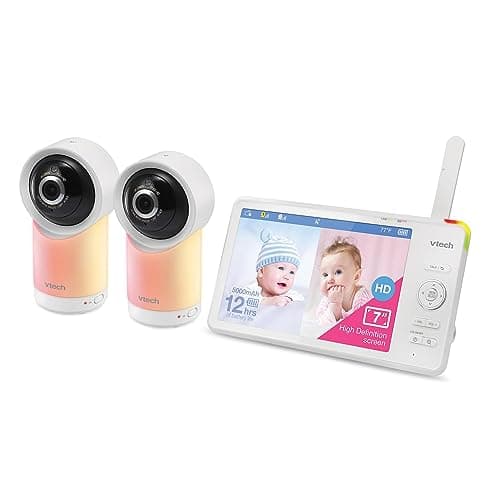
Update, August 2026: the VTech half of this matchup has a new model number. VTech has retired the RM5766— it now shows as unavailable on Amazon — and replaced it with the RM7766-2HD. It is the same system in every way that mattered here: two 1080p pan-and-tilt WiFi cameras, a dedicated parent screen, a night light, and the same remote app. The one real change is that the parent unit grows from a 5-inch screen to a 7-inch one. We have left this page up because the question it answers is still a live one, but we won't send you to a dead listing, so the VTech card below and everything written from here down refers to the RM7766-2HD.
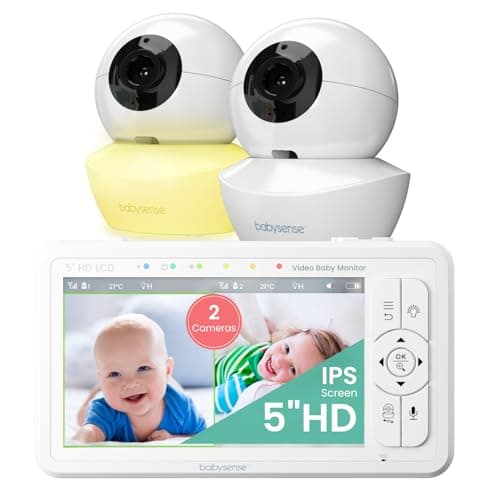
Quick verdict: choose the Babysense HD S2if privacy and simplicity matter most, because it runs on a private no-WiFi radio link that cannot be reached over the internet—there is nothing to hack remotely—and it bundles two cameras, a split-screen parent unit, a night light, and a sound machine at a value price; choose the VTech RM7766-2HDif you want to check in on your baby when you are away from home, because it is a hybrid that pairs a dedicated parent screen with a phone app for remote viewing, and its cameras are sharper. Both come with two cameras and a dedicated parent screen—5 inches on the Babysense, 7 on the VTech—so both are built for the same core job—watching two rooms at once—and the real decision between them is privacy versus remote access.
We have not run either monitor through a hands-on lab test—we rank from each maker's published specifications, the product manuals, widely documented facts, and our methodology, so treat this as a features-and-fit comparison rather than a wear-tested review. If you want to see the whole category first, our best baby monitors roundup ranks every type; this page is the head-to-head for the two two-camera monitors parents most often compare when they need to cover more than one room and are deciding whether WiFi belongs in the nursery at all.
What these two share, and where they split
On paper the overlap is real: both the Babysense HD S2 and the VTech RM7766-2HD ship with two cameras and a dedicated parent screen, both are designed to show you two rooms at once, and both are geared to families covering, say, a nursery and a toddler's room, or a crib and a play area. The split is how they carry the video from camera to parent. The Babysense uses a private 2.4GHz FHSS radio link between its own cameras and its own screen—a closed connection with no internet involved. The VTech is a smart WiFi monitor: it still gives you a dedicated local parent screen at home, but it also connects to your home WiFi so a companion phone app can stream the same feed from anywhere. That one architectural difference drives almost everything else that follows, from what you can and cannot do when you leave the house to what you have to think about to keep the feed secure.
Privacy versus remote viewing: the core decision
This is the heart of the comparison. The Babysense HD S2 is a closed system: because it never touches the internet, its video cannot be reached remotely, which for a lot of parents is exactly the point—there is no account, no cloud, and no online attack surface to worry about. The trade-off is equally clear: there is no phone app and no away-from-home viewing, so you can only watch on the parent unit while you are in range at home. The VTech RM7766-2HD makes the opposite trade. Its phone app lets you look in on your baby from work, from the yard, or from anywhere you have a signal, and it adds two-way talk and alerts—genuinely useful if a grandparent or sitter is on duty and you want to check in. But the WiFi side has to be secured: change the default password to a strong unique one, turn on any two-factor authentication the app offers, and keep the firmware updated, exactly as you would for any internet-connected camera in your home. Our WiFi vs. no-WiFi baby monitors guide walks through this decision in more depth if you are torn.
Cameras, screens, and picture quality
The VTech is the sharper camera on paper. Its two cameras record in 1080p and add 360-degree pan, tilt, and zoom, so you can sweep a room and follow a mobile toddler from the parent unit or the app. The Babysense cameras feed a 5-inch HD split-screen so you can watch both rooms side by side at a glance, which is its own kind of convenience. There is one honest caveat that applies to the VTech: its parent screen is 720p, which is below its own cameras' 1080p resolution, so you see the full detail on the phone app rather than on the handheld screen. The Babysense's display sits in the same 720p HD tier and is a step below the picture you would get from a premium smart WiFi camera. In practice both give you a clear, usable view of a sleeping baby; if maximum sharpness and the ability to pan and zoom matter to you, the VTech leads, and if a simple, reliable split-screen of two rooms is what you actually want, the Babysense delivers it.
Battery, range, and extras
The Babysense leans into being a self-contained nursery device. Its parent unit carries a 4000mAh battery rated for roughly 20 hours in eco mode and a range of up to about 1,000 feet, and it folds in a night light and a sound machine—small touches that mean one device can soothe as well as watch. It is also expandable to four cameras if your needs grow beyond two rooms. The VTech does not publish a runtime figure for the RM7766-2HD's parent unit, so we won't put a number on it, though the always-on WiFi streaming naturally asks more of the battery than a closed radio link does. Neither approach is wrong; the Babysense is the longer-running, more standalone unit with the built-in soothing extras, while the VTech spends some of its battery budget on the remote-viewing flexibility that is its whole reason for being.
A monitor is a wellness device, not a medical one
This applies to both monitors and it is worth stating plainly: a baby monitor is a convenience and wellness device, not a medical device. Neither the Babysense HD S2 nor the VTech RM7766-2HD diagnoses anything, and—this is the important part—no baby monitor prevents SIDS or replaces safe sleep. A camera helps you see and hear your baby from another room; it does not make the crib safer. The things that reduce risk are the safe-sleep basics that apply no matter which monitor you own: put your baby to sleep on their back, on a firm, flat mattress, with a fitted sheet and nothing else in the crib—no bumpers, pillows, blankets, or soft bedding. Use the monitor as an extra set of eyes and ears, not as a safety guarantee, and take any health concern to your pediatrician rather than to a device readout.
Where you put the camera matters
One safety point applies to both monitors and to every corded camera: keep the cords well away from the crib. A monitor cord within a baby's reach is a strangulation hazard, so mount or place the camera out of arm's reach and route the power cord so it cannot be pulled into the crib—a good rule of thumb is to keep any cord at least three feet from where your baby sleeps. Both the Babysense and the VTech give you a wide enough view that you do not need the camera right at the crib rail to see your baby, so mount it high on a wall or shelf across the room where it can take in the whole crib. Think about angle and light too: point the camera to cover the entire sleeping space, and check the view at night as well as during the day so you know it works when you will actually rely on it. If you expand the Babysense to more cameras, or add the second room on either system, apply the same cord-and-placement rule to every camera and not only the one over the crib. Placing each camera thoughtfully gives you a better view and removes a hazard at the same time, whichever monitor you choose.
There is no wrong answer here—both are capable two-camera monitors that cover two rooms well. Reach for the Babysense HD S2 if you want the privacy of a no-WiFi link, the simplicity of a self-contained system, and the bonus of a night light and sound machine at a value price; reach for the VTech RM7766-2HD if the ability to check in on your phone from anywhere, sharper 1080p cameras, and pan-and-tilt are worth taking on the small job of securing a WiFi connection. If you are still deciding what kind of monitor suits your home, our how to choose a baby monitor guide helps you match the features to how you actually live.