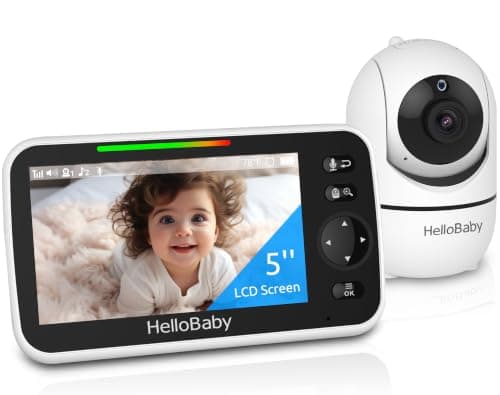
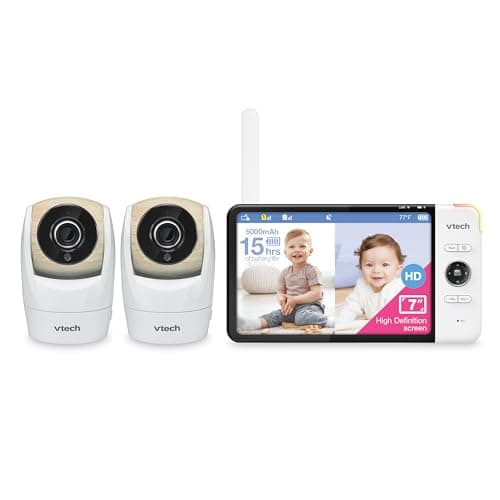
Quick verdict: pick the HelloBaby HB6550if you're watching one room and want the lowest-cost, no-fuss monitor with a long standby battery, and pick the VTech VM919-2HD if you need to see two rooms or two children at once, because it ships with two cameras and a larger split-screen instead of making you buy a second unit. Both are budget, local-only video monitors with no app and no account, so the picture never touches the internet.
A quick note on how we got here: we rank these from published manufacturer specs and our own scoring method, not a hands-on lab teardown, so we are careful to flag where a difference is genuinely meaningful and where it simply comes down to how many cameras your home needs. You can read exactly how we weigh screen, range, battery, and value in our methodology. Both of these monitors sit squarely in the same private, no-WiFi category, and both handle the core job well; the rest of this page is about matching the right one to your specific setup.
Why non-WiFi at all
Both of these are non-WiFi monitors, and that shared trait is the whole point of pairing them. The camera and the handheld screen talk directly to each other over a closed radio link, so the video never leaves your home. There is no app to log into, no cloud account to create, and no online service sitting between you and your baby that could be breached to reach the feed. That is a real, concrete privacy advantage over smart WiFi cameras, and it is exactly why many parents shop this category in the first place. We put it honestly, though: having no internet connection means dramatically less attack surface, not that any device is unhackable. The trade-off is the other side of the same coin. Because nothing goes online, you cannot check in from work or from vacation, you will not get alerts pushed to your phone, and you cannot save or share clips. If any of that matters to you, weigh it before you commit in our WiFi vs non-WiFi guide— because neither monitor on this page can do it.
Screen and image quality
The clearest hardware difference between the two is the screen. The VTech VM919-2HD has the larger display and is built around a split-screen layout, which is what lets it show two camera feeds side by side at the same time; the HelloBaby HB6550 uses a smaller handheld screen sized for a single feed. If you like a big, glanceable picture sitting on the nightstand, the VTech is simply the more comfortable one to look at. Neither is a high-resolution smart camera, and both product notes are candid about that: picture quality on these budget local monitors sits below what a premium WiFi camera delivers. That is normal for the price and for the category, and for the actual task — confirming that your baby is asleep and breathing calmly — both are perfectly legible in daylight and in night vision. If truly pin-sharp video is a priority for you, that is an argument for a different class of monitor altogether, not for choosing one of these two over the other.
Range and battery life
On paper the two are evenly matched for coverage: both are rated up to 1,000 feet, a figure that assumes clear, open line-of-sight with nothing in the way. In a real house, with walls and floors between the camera and the screen, expect noticeably less than that from either unit — and that caveat applies to every monitor in this category, not just these two. For a typical home, both will reach comfortably from a nursery to a bedroom or a living room. Battery is where the HelloBaby has a documented edge: its parent screen is rated up to 30 hours in VOX (voice-activated) mode, which blanks the display until a sound wakes it. Leave any monitor's screen lit continuously and it will drain far faster, so treat that 30-hour number as a power-saving best case rather than what you will see with the display always on. The VTech, which drives a bigger screen and pairs with two cameras, is not designed to be the standby-battery champion, so if all-day cordless runtime on the parent unit is your top concern, the HelloBaby is the safer pick.
One camera or two: multi-room coverage
This is the single decision that should drive your choice. The VTech VM919-2HD comes with two cameras in the box and a split-screen built to show them together, so it is ready out of the box on day one for a two-child or two-room home — and you are not paying a premium for each extra camera to get there. The HelloBaby HB6550 ships as a single-camera unit. It does support adding more cameras later, so it is not locked to one room forever, but you would buy that second camera separately, and it is not built around a true side-by-side split-screen the way the VTech is. So the math is refreshingly simple. If you already know you need eyes on two spaces — two children, or a crib and a playroom — the VTech is both the easier and usually the cheaper path than a single monitor plus a bolted-on second camera. If you only ever need one view, the HelloBaby's single camera is no drawback at all, and buying the two-camera set would just mean paying for a camera you never switch on.
Night vision, temperature, and the other extras
Beyond the headline specs, these two share most of the features parents actually reach for night after night. Both have infrared night vision so you can see into a fully dark nursery, both offer pan, tilt, and zoom to reframe the crib without getting up to move the camera (the VTech's camera pans a full 360 degrees), and both include two-way talk so you can soothe from another room, along with a room-temperature readout right on the screen and soft lullabies you can play from the camera. None of this has to be set up through an app; it all lives on the handheld unit. The practical upshot is that on the day-to-day extras there is no meaningful winner between them. The things that genuinely separate these monitors are the ones already covered above — screen size, standby battery, and the one-camera-versus-two question. Almost everything else is close to a wash, which is a good outcome at this price.
Value: which is the smarter buy
Value depends entirely on how many cameras you need, so there is honestly no single winner to crown. For a one-room household, the HelloBaby HB6550 is the value pick outright: it is the cheaper monitor, it has the longer rated standby battery, and it does everything a single-nursery setup asks of it. For a two-room or two-child household, the VTech VM919-2HD is the better buy, because getting two cameras and a split-screen together in one box costs less than buying a single-camera monitor and then adding a second camera to it. The one thing to steer clear of is buying the two-camera set and only ever using one of the cameras — that is money you did not need to spend. Decide by rooms first and by budget second, and the right one tends to pick itself.
Either way, you are getting a private, local-only monitor that keeps your baby's video off the internet entirely, which is the whole reason to shop this category to begin with. Choose the HelloBaby HB6550 for the cheapest solid single-room setup, or the VTech VM919-2HD when two rooms or two kids are in the picture. If you want to see how these two stack up against the rest of the field before you commit, our best non-WiFi baby monitorsroundup ranks the full lineup — and it is always worth a quick look at the CPSC recalls listing in our sources for any monitor you are considering.