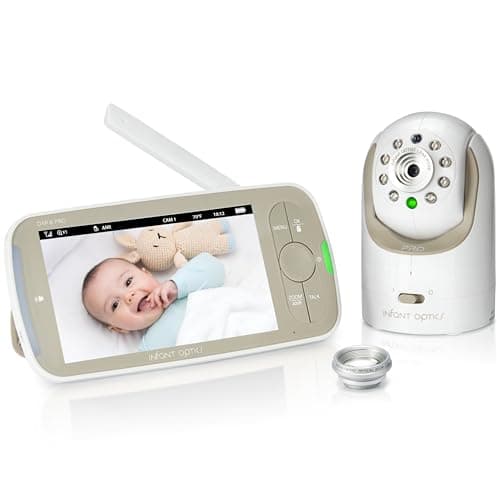
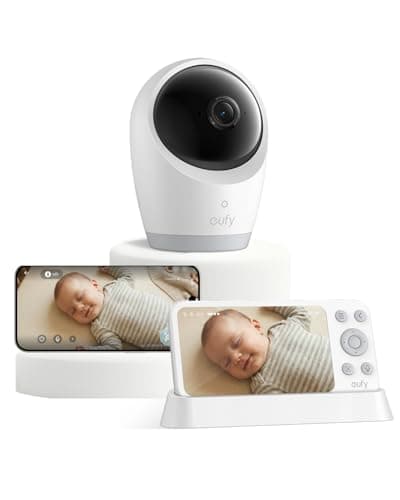
Both of these are screen monitors— they come with a dedicated parent unit, so there's no phone required to watch your baby — but they take different stances on connectivity. The Infant Optics DXR-8 PROis pure no-WiFi: it uses a closed radio link with no internet connection, so it can't be reached or hacked over the internet. The eufy E21 is a local screen monitor by default that also offers an optionalWiFi app if you want remote viewing — flexibility the Infant Optics deliberately doesn't have.
Quick verdict: pick the Infant Optics if privacy and simplicity are the priority and you never want an internet-connected camera in the nursery; pick the eufy if you want a great local screen most of the time but like the option to check from your phone. We haven't lab-tested either; this leans on published specs and our methodology, the rubric behind our best no-WiFi baby monitors roundup.
Privacy: closed link vs optional cloud
The Infant Optics' whole appeal is that there's nothing to hack from afar — no app, no cloud, no internet, just a private link between camera and screen. For families who don't want a networked camera watching their child, that's the point. The eufy runs locally too by default, but its optional app means that if you enable remote viewing, you take on the same security responsibilities as any WiFi camera: strong password, updates, and so on. You can leave the app off and use it as a pure local monitor, which is a nice middle ground — local now, flexible later. Our WiFi vs no-WiFi guide covers this trade in depth.
Camera and viewing features
The Infant Optics' standout hardware trick is interchangeable lenses— you can swap in a wide-angle or zoom lens to suit the room — along with active noise reduction to cut ambient hum. The eufy leans on a motorized pan-tilt-zoomcamera with a high-resolution sensor and generous zoom, so you can sweep the room from the parent unit, plus a portable, battery-powered camera. If you want to physically re-aim the camera remotely, the eufy's pan/tilt wins; if you value lens flexibility and a proven, simple screen, the Infant Optics is the pick.
Range, battery, and everyday use
Both are designed as in-home monitors with their own parent screens, so they work through the house without relying on your router. The eufy's camera is battery-powered and portable, which is handy for travel or moving between rooms; the Infant Optics is the more plug-and-play, no-setup experience — turn it on and it pairs, no accounts or apps. If you want the least fuss, the Infant Optics is about as simple as monitors get; if you want portability and remote re-aiming, the eufy offers more.
Value and who each is for
Both are mid-to-upper-range screen monitors, and prices move with sales — check the cards below. Choose the Infant Optics DXR-8 PRO for maximum privacy, interchangeable lenses, and dead-simple operation with no internet. Choose the eufy E21 for a strong local screen with pan/tilt and the option to add app viewing when you want it. For the whole field, see our best baby monitors roundup. Live prices and specs are in the cards below.