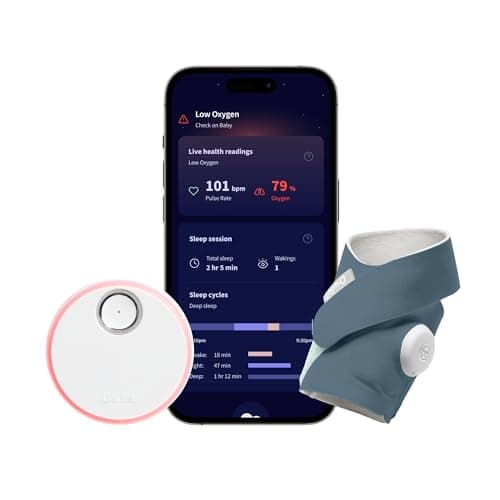
Owlet Dream Sock Review: Reassurance, Honestly Described
The only FDA-cleared wearable baby monitor of its kind — which is a narrower claim than most people hear. Here is precisely what it measures, what it cannot tell you, and who it is actually for.
Disclosure:Swaddle & Stroll is reader-supported. When you buy through links on this page we may earn an affiliate commission, at no extra cost to you. It never changes our picks. How this works.
The Owlet Dream Sock is worth buying for one reason: it lets an anxious parent of a healthy baby aged 1 to 18 months see a live pulse rate and oxygen reading, and be alerted if either leaves a preset range. That is genuine reassurance, and the FDA granted it a De Novo clearance for exactly that in November 2023. It is not a SIDS monitor, it is not a camera, and it does not replace a single safe-sleep rule. If you want to see your baby, you still need a monitor as well.
Per how we pick: we have not clinically tested this device. What follows is built from Owlet's own published specifications, the FDA De Novo record, the American Academy of Pediatrics' safe-sleep guidance, and the current Amazon listing. The hardest part of reviewing this product is being clear about the gap between what it is cleared to do and what parents hope it does, so we have put that first.
The verified specifications
Spec
Owlet's published figure
Cleared for
Healthy babies 1–18 months, 6–30 lb
Measures
Live pulse rate and oxygen level (pulse oximetry); sleep patterns, wakings and trends
Battery
Up to 16 hours; 8 hours of charge in 20 minutes; full charge in 90 minutes
Socks included
Four fabric socks — sizes 1 and 2, in right and left versions
Base Station
Wireless charging, USB-C powered, colored light notifications and audible alerts
Free in the app
Live readings, historical sleep and wellness data, Health Notifications, sleep trend charts, Predictive Sleep
Owlet360 adds
Daily morning report, comparison with similar-aged babies, sleep environment trends
Camera
None — this is a wearable, not a video monitor
Living with it
The sock sizing is better than it used to be. Four socks in the box, two sizes with left and right versions, covers the cleared 6 to 30 lb range without a second purchase. The socks are fabric and washable, which matters because this is an item that will be worn most nights for a year.
The battery is the daily habit. Up to 16 hours means one overnight plus naps, then back on the base. The fast charge is the useful number here: 20 minutes buys eight hours, so a sock forgotten on the changing table at bedtime is a recoverable mistake rather than a lost night.
The Base Station is what makes it work at 3 a.m.It charges the sock wirelessly and, more importantly, gives colored light and audible alerts in the room — so the alert does not depend on your phone being unmuted and in the right place.
Most of the app is free.This is worth saying because it is unusual in the smart-monitor category: live readings, Health Notifications, historical sleep data, trend charts and Predictive Sleep need no subscription. Owlet360 is an optional upgrade that adds a daily morning report, comparison against similar-aged babies, and sleep environment trends. Compare that with the camera-based smart monitors, where the analytics people buy the product for usually sit behind an annual plan — our best WiFi baby monitors roundup covers which ones charge for what.
The first week, and how to avoid fighting it
Almost every complaint about this product traces back to sock fit, so it is worth getting right on night one. The sock goes on the foot the app tells you, snug enough not to slide but not tight, with the sensor positioned as the instructions show — a sock that rotates during the night is the single most common cause of a reading that drops out and an alert that wakes you for nothing. Owlet includes two sizes precisely because a sock that fit at eight weeks will not fit at six months; check the size against your baby's current weight whenever the readings get flaky rather than assuming the device has failed.
Set expectations about the numbers, too. A pulse oximeter on a moving baby is not a hospital monitor on a still one: readings fluctuate, brief dips are normal, and the device is designed to notify you when values sit outside the preset range rather than to present a continuous clinical trace. If you are the kind of person who will open the app at 2 a.m. to study a chart, this product may give you something new to worry about rather than taking worry away — and that is a reason not to buy it, not a flaw in the hardware.
Finally, treat the Base Station as the alert, not your phone. Put it where you will hear it, keep the phone notifications on as a backup, and do not rely on a watch or a muted handset to be the thing that tells you something changed.
The honest cons
It is not a camera, so for most families it is a second purchase alongside a monitor, not a replacement for one. Budget accordingly.
The window closes at 18 months and 30 lb. The clearance is specific. Many babies hit 30 lb well before 18 months, and when they do you are outside the cleared range.
It can produce false alarms. A sock that slips, a very wriggly sleeper, or a poor reading will alert you. For some parents that is a tolerable cost of the reassurance; for others it adds anxiety rather than removing it, which is the honest reason this product is not for everyone.
It is for healthy babies.If your baby has a diagnosed cardiac or respiratory condition, this is a consumer wellness device and the wrong tool — that is a conversation with your pediatric team, not a purchase.
It is expensive for what it does, especially once you add the camera it does not include.
It requires charging every single day. A flat sock monitors nothing.
Who it is for
Buy it ifyou are a parent whose anxiety is specifically about breathing and you know that a number on a screen will settle you rather than wind you up. That is a real and common experience, and for those families the Dream Sock does something no camera can. It is also a reasonable choice for a baby who came home after a NICU stay and whose team is comfortable with it — ask them first.
Skip it ifyou suspect alerts will make you worse, if your budget only stretches to one device (buy a camera — seeing the baby solves more daily problems), or if you are buying it because you believe it prevents SIDS. It does not, and we would rather lose the sale than let anyone buy it on that understanding.
Two situations where it earns its place more than the spec sheet suggests. The first is travel: the Sock and its Base Station pack into a bag and work in a hotel room or a grandparent's spare room, where you have no camera mounted and no familiar sounds to read. The second is the handover — a partner, a night nanny or a relative taking a shift gets the same information you do, which can be the difference between actually sleeping and lying awake listening. Neither is a safety argument. Both are reasons people keep using it past the first month.
The alternatives worth comparing
If you want vitals and a view, Owlet's own Dream Sight camera pairs with the Sock and keeps its core features subscription-free. If you would rather have one device that does sleep analytics from overhead, our Dream Sock vs Nanit comparison is the direct head-to-head. And if the real goal is simply to hear and see your baby reliably with nothing on the internet, best no-WiFi baby monitors is the cheaper and, on privacy, the stronger answer. Still deciding whether you need any of this? Do you need a baby monitor is the page to read first, and safe sleep guidelines is the one that actually reduces risk.
A wearable sock that tracks the baby's pulse rate and oxygen and alerts your phone — FDA-cleared as an over-the-counter infant pulse oximeter, though it is not cleared to detect or prevent SIDS.
Type
Wearable sock sensor + app
Tracks
Pulse rate & oxygen saturation
Alerts
Phone notifications and base-station chime
Cleared for
FDA De Novo (Nov 2023), OTC — healthy infants 1–18 months, 6–30 lb
What we like
FDA-cleared Health Notifications when readings leave the preset range
Phone alerts and sleep insights
Comfortable, washable sock
Worth noting
Not cleared to detect or prevent SIDS, and no substitute for safe sleep
Higher price; pairs best with a separate camera
How it scored
App & features9.0
Reassurance value9.2
Reliability8.4
Value7.8
Frequently asked questions
Is the Owlet Dream Sock FDA approved?+
It is FDA cleared, not approved — the distinction matters. In November 2023 the FDA granted a De Novo clearance (DEN220091) for use as an over-the-counter infant pulse rate and oxygen saturation monitor in healthy infants 1 to 18 months and 6 to 30 pounds. That covers the accuracy of the readings and the Health Notifications, and nothing beyond it.
Does the Owlet Dream Sock prevent SIDS?+
No. Owlet states it is not intended to diagnose, treat or cure any disease or condition, including SIDS or RSV, and the American Academy of Pediatrics is explicit that home cardiorespiratory monitors should not be used as a strategy to reduce SIDS risk. Back sleeping on a firm, flat, bare surface, and room sharing without bed sharing, are what reduce risk.
How long does the Owlet Dream Sock battery last?+
Owlet publishes up to 16 hours per charge, with 8 hours of runtime restored in a 20-minute charge and a full charge in 90 minutes. In practice that is one night plus naps, then back on the Base Station — it needs charging daily.
Do you need a subscription for the Owlet Dream Sock?+
No. Live readings, Health Notifications, historical sleep and wellness data, sleep trend charts and Predictive Sleep are all included with no plan. Owlet360 is optional and adds a daily morning report, comparison with similar-aged babies, and sleep environment trends.
Does the Owlet Dream Sock have a camera?+
No. It is a wearable sensor only. If you want to see your baby you need a separate monitor — Owlet's own Dream Sight camera pairs with it, or any of the cameras in our baby monitor roundups will do the job.
What age can you use the Owlet Dream Sock until?+
The clearance covers healthy babies from 1 to 18 months and 6 to 30 pounds. Whichever limit your baby reaches first is the end of the cleared range, and plenty of babies pass 30 pounds before 18 months.