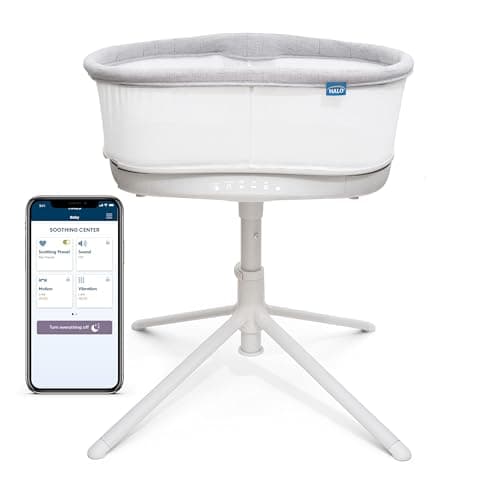
A bedside bassinet that swivels over the mattress and drops its wall so you can reach the baby without standing up. For some families that is worth every dollar; for others it is $400 for five months.
Disclosure:Swaddle & Stroll is reader-supported. When you buy through links on this page we may earn an affiliate commission, at no extra cost to you. It never changes our picks. How this works.
The HALO BassiNest earns its price for one group of families, and for them it is close to unanswerable: anyone who cannot easily get out of bed. After a C-section, a difficult delivery, or with a back or mobility problem, the 360-degree swivel brings the baby over your mattress and the lowering wall drops out of the way, so a night feed takes a reach instead of a stand, a twist and a bend. If you can get out of bed comfortably, you are paying a premium for convenience on a product your baby outgrows at 20 pounds — roughly five months.
Per how we pick: we have not run this bassinet for a year and we do not claim to have. What follows comes from HALO's published specifications as listed by its retailers, the current Amazon listing, the federal bassinet standard, and the AAP's safe-sleep guidance — which matters more here than on any other product category we cover, because this is where a baby sleeps.
Which BassiNest you are actually buying
Worth getting straight before you compare prices, because the name is reused. The BassiNest Swivel Sleeper 3.0 is the base model: swivel, lowering wall, mesh walls, flat firm mattress pad. The Connected Swivel Sleeper 3.0is the smart version, and it is the one currently stocked on the Amazon listing we link — it adds AutoSoothe, which responds automatically when it detects crying with rocking, vibration and a choice of sounds, plus control from the HALO app or the panel on the bassinet itself, and HALO's staged sleep programs.
Both versions share the same bedside geometry, the same 20 lb limit and the same 2-in-1 conversion into a detachable portable nest. The swivel and the wall are what you are really buying; the soothing hardware is the upsell.
The verified specifications
Spec
Published figure
Weight limit
Birth to 20 lb — stop when the baby begins to push up on hands and knees, or at 20 lb, whichever comes first
Overall size (Connected 3.0)
34 in W x 26 in H x 34 in D
Height adjustment
Adjustable to suit beds up to 30 in high
Product weight
30 lb (Connected 3.0). Retailers list the base 3.0 lighter, around 22.6–23 lb
Swivel
360 degrees — rotates over the bed and away again
Bedside wall
Lowers for access without bending or twisting
Walls
Breathable mesh, 100% polyester
Soothing (Connected only)
AutoSoothe responds to detected crying; rocking, vibration and calming sounds in many combinations; app or on-unit control; staged sleep programs
2-in-1
Converts to a detachable portable nest — for an awake, supervised baby only
Included
100% cotton fitted sheet, mattress pad (polyester with a foam core); compatible with BassiNest accessories including the Newborn Insert
Certification
JPMA certified
Retailer listings disagree on the base model's footprint — some publish a 34 x 34 in base and others a 47 x 47 in figure, and quoted heights range from 36 in up to 44.5 in depending on the listing and the version. Treat the 34-inch square as the working number for the Connected 3.0 and measure the gap beside your bed before you order. The one figure nobody disputes is the one that matters most: the bed it stands beside can be up to 30 inches high.
What the swivel actually solves
It is easy to read “360-degree swivel” as a gadget. It is not. The thing it removes is the specific sequence that hurts after abdominal surgery: sit up, twist, push off the mattress with your arms, stand, bend over a fixed bassinet wall, lift, straighten. The BassiNest replaces that with rotating the whole basket over your mattress and dropping the near wall, so the baby comes to you at roughly bed height.
Multiply by eight to twelve wakings a night in the early weeks and the value stops being theoretical. This is the reason it is our bedside-recovery pick in best bassinets, and the reason we would choose it over a cheaper bassinet for a C-section recovery even though the cheaper bassinet offers the same quality of sleep surface.
The honest counterpoint: if you can get out of bed without difficulty, the swivel is a convenience rather than a solution, and a flat, firm, standards-compliant bassinet costs a great deal less. Our how to choose a bassinet guide starts from what you actually need rather than from a feature list.
AutoSoothe, described accurately
On the Connected model, AutoSoothe listens for crying and responds on its own with rocking, vibration and a sound, in a large number of configurable combinations, and HALO layers staged sleep programs on top — including ones aimed at colic and at weaning off motion. You can drive it from the app or the panel on the bassinet.
Two caveats worth holding onto. First, it is a soothing feature, not a safety feature; automatic motion does nothing for sleep safety and is not a monitor — if you want to see or hear the room, that is a separate device, and best baby monitors covers it (our Infant Optics DXR-8 PRO review covers the no-WiFi option in detail, if you would rather not put a camera online). Second, a baby who falls asleep only to motion has to be weaned off it eventually, which is why HALO ships a weaning program at all. If a cry-responsive smart bassinet is the category you are actually shopping, HALO BassiNest vs Graco Sense2Snooze is the direct comparison.
The honest cons
Five months, maybe six.Twenty pounds or the first push-up, whichever comes first — and plenty of babies hit the milestone well before the weight. This is the central objection to the whole product: it is a lot of money per month of use.
It is not small.A 34-inch square footprint and about 30 lb of weight make this a piece of furniture beside your bed, not something you tuck into a corner. In a small bedroom, measure first — nursery furniture for small spaces is the right starting point if space is the binding constraint.
Your bed must be under 30 inches.Tall platform beds and deep mattress stacks can put the mattress top above the bassinet's range, which defeats the entire bedside design. Measure from the floor to the top of your mattress before buying.
The portable nest is narrower in use than it sounds.Detached, it is for a supervised, awake baby only, so it is a safe place to put the baby down in another room while you are in it — not a travel sleeper. For travel sleep you want a different product; bassinet vs pack and play explains why.
The smart version needs mains power and an app. Fine for most bedrooms; worth knowing if you want a bassinet with nothing to plug in or sign into.
Soothing features do not fix a baby who will not settle. If that is the problem you are trying to buy your way out of, why won't my baby sleep in the bassinet is more likely to help than any amount of hardware.
Resale is the only thing that fixes the cost.Bassinets hold value reasonably well precisely because they are outgrown fast. Factor that in rather than pretending the sticker is the real cost — and if the budget is the issue, best budget nursery furniture is the honest alternative route.
Who should buy it, and who should not
Buy the BassiNest if you are recovering from a C-section or a hard delivery, you have a back or mobility issue, or you simply know that the thing most likely to break you in month one is repeatedly standing up at 3am. That is a real problem and this is a genuinely good solution to it.
Buy something else if getting out of bed is easy and you are choosing on features. The sleep surface is what keeps a baby safe, and a flat, firm, standards-tested bassinet delivers that for a fraction of the money. If you would rather skip the bassinet stage entirely, bassinet vs crib makes that case honestly, and best cribs and best crib mattressesare where that money goes instead — on something used for three years rather than five months.
The 360° swivel and lowering bedside wall let you tend to the baby without getting up — a genuine relief after a C-section, and a flat, firm sleep surface throughout.
Sleep surface
Flat and firm (AAP-aligned)
Swivel
360° rotation over the bed
Wall
Lowering bedside wall
Weight limit
Up to 20 lb / until baby can push up
What we like
Swivels the baby to you without standing
Flat, firm surface follows safe-sleep guidance
Bedside wall lowers for easy reach
Worth noting
Premium price
Larger floor footprint
How it scored
Safe-sleep design9.6
Bedside convenience9.6
Build quality9.0
Value7.8
Frequently asked questions
How long can a baby use the HALO BassiNest?+
From birth to 20 lb, and you must stop as soon as the baby begins to push up on hands and knees or can roll — whichever happens first. In practice that is roughly five months, and often less, because many babies hit the push-up milestone before the weight limit.
Is the HALO BassiNest worth the money?+
For a C-section recovery, a difficult delivery, or a back or mobility problem, yes — the 360-degree swivel and lowering wall turn a night feed from standing, twisting and bending into a reach, and that compounds over eight to twelve wakings a night. If you can get out of bed comfortably, you are paying a premium for convenience on a product that lasts about five months.
What is the difference between the BassiNest 3.0 and the Connected 3.0?+
The 3.0 is the base model: 360-degree swivel, lowering bedside wall, breathable mesh walls and a flat firm mattress pad. The Connected 3.0 adds AutoSoothe, which responds automatically when it detects crying with rocking, vibration and sounds, plus control from the HALO app or the on-unit panel and HALO's staged sleep programs. The bedside geometry and the 20 lb limit are the same on both.
Will the HALO BassiNest fit my bed?+
It is height-adjustable for beds up to 30 inches high, measured from the floor to the top of your mattress. Tall platform beds or deep mattress stacks can exceed that and defeat the bedside design, so measure before ordering. Allow for a footprint of roughly 34 inches square on the Connected 3.0.
Does the HALO BassiNest prevent SIDS?+
No. No bassinet, monitor or soothing feature has been shown to prevent SIDS. Safety comes from safe-sleep practice: a firm, flat surface, baby on the back, in the parents' room for the first six months, with nothing loose in the sleep space. Use only the mattress pad and fitted sheet made for the bassinet.
Can the baby sleep in the detachable portable nest?+
No. HALO states the detached nest is for use only while the baby is awake and supervised. It is a safe place to set the baby down in a room you are in, not a sleep surface or a travel sleeper.
Is the HALO BassiNest certified safe?+
It is JPMA certified, and bassinets and cradles sold in the US are governed by 16 CFR Part 1218. Certification means it was tested to the applicable standard for things like stability, structure and sleep surface — it is not a claim about sleep outcomes.