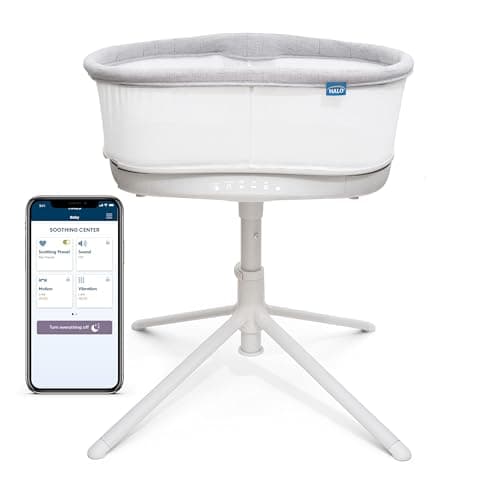
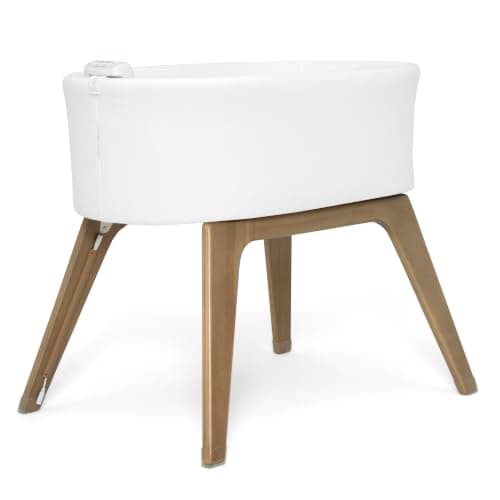
Update, August 2026: the Graco half of this matchup is no longer buyable. Graco's cry-detection bassinets — the original Sense2Snooze and the SmartSensethat succeeded it — both show as unavailable on Amazon, and Graco has retired the Sense2Snooze to the point of no longer supplying replacement parts for it. We have left this page up because the question it answers is still a live one, but we won't send you to a dead listing. The bassinet we now put opposite the BassiNest is the Delta Children Aero Smart Auto Glide Bassinet, which is the same idea: it listens for the baby and responds on its own. Both cards below are current, in-stock products.
These two give a newborn a sleep space right next to your bed, but they solve different problems. The HALO BassiNest is built around access: it swivels 360 degrees over the bed and has a lowering side wall so you can reach or feed your baby without getting up. The Delta Aero Smart is built around soothing: it detects your baby's cry and answers with a quiet side-to-side glide, a sound or lullaby, or a low amber light — the job the Graco used to do here.
Quick verdict: pick the BassiNest if bedside access matters most — especially while recovering from a C-section or birth — and pick the Aero Smart if hands-free soothing is what you want. We haven't tested either in a lab; this leans on published specs and our methodology, the rubric behind our best bassinets roundup. Whatever you choose, the sleep rules are the same on both.
Bedside access vs auto-soothing
The BassiNest's swivel-and-lower design is genuinely useful in the newborn weeks: it brings the baby to you rather than making you climb out of bed, and the lowering wall makes reaching in easy for a recovering parent. It doesn't rock or auto-soothe — it's a still, safe place to sleep with excellent access. The Aero Smart goes the other way: cry detection triggers a response you choose — six glide speeds, seven sounds, three lullabies, and three amber-light settings, set from Delta's app, with Bluetooth if you'd rather stream your own. That's the appeal, with one honest caveat — auto-soothing helps, but it won't replace every night wakeup, especially when a baby is hungry.
Footprint and how long each lasts
Both are larger than a basic bassinet, so measure the space beside your bed. The BassiNest's base is designed to tuck under the bed frame so the sleep surface floats over the mattress edge; the Aero Smart is a floor-standing unit on FSC-certified wood legs, 33.25 by 25 inches on the floor. Check the use windows too, because they differ: Delta rates the Aero Smart to five months or 30 pounds, and says to stop at whichever comes first, or as soon as your baby pushes up on hands and knees. Neither is a travel piece — if you need something that packs down, a playard with a bassinet insert is the better tool.
The safety basics apply to both
A soothing feature never changes the safe-sleep rules. On either bassinet, your baby sleeps on their back, on the flat firm surface, with a fitted sheet and nothing else — no loose blankets, pillows, or padding, and no incline. Both have weight and development limits: most bassinets, including these, should be retired once your baby reaches the stated weight limit (often around 15 to 20 pounds) or starts to push up on hands and knees or roll, whichever comes first — at which point the baby moves to a crib. Use the motion or sound features for settling, not as a reason to leave a baby unattended. Our safe-sleep guidelines cover the full list.
Value and who each is for
Both are premium bassinets, and both move with sales — check the live prices on the cards below. Choose the HALO BassiNest if easy bedside access and a swivel for feeding and recovery top your list. Choose the Delta Aero Smart if hands-free, cry-triggered soothing is the feature you most want, and you can live with the shorter five-month window. If you came here for the Graco, the Aero Smart is the closest thing you can actually buy today. Live prices and specs are in the cards below.