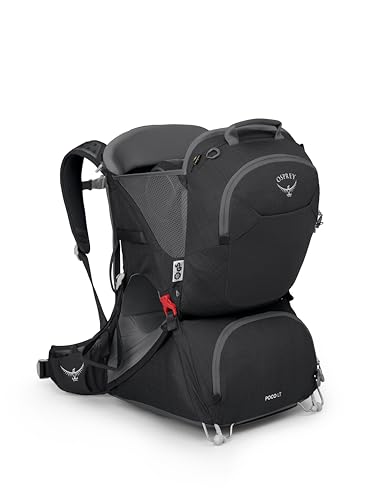
Five framed child carriers ranked on the four specs that decide a day out: the real total load ceiling, whether the sunshade is actually included, how far the torso adjusts, and how much of your 48 lb budget the carrier itself eats.
Disclosure:Swaddle & Stroll is reader-supported. When you buy through links on this page we may earn an affiliate commission, at no extra cost to you. It never changes our picks. How this works.
Buy the Osprey Poco LT. Its sunshade is included and lives in a dedicated zip pocket on the carrier, which sounds like a detail and is in fact the whole thing: three of the five carriers here sell the sunshade separately, and a sunshade you have to remember is a sunshade you leave in the car. It also has six inches of torso adjustment, 25 liters of cargo so you are not wearing a second bag, and Osprey’s seven-year guarantee. If your child falls asleep in everything, the Deuter Kid Comfort’s chin pad and side-entry loading are worth the extra two pounds. If two adults of different heights will both carry, the Kelty’s 15.5-to-21-inch range is the widest here.
First, the important one. Do not buy a framed carrier at allif what you are actually doing is a mile of paved trail with a four-month-old. A frame is for a child who can sit up unassisted — usually around six to nine months — and for distances where your own shoulders are the limiting factor. Below that, a soft structured carrier is lighter, cheaper, closer to the child and better in every way that matters. Our best baby carriers page covers those, and wrap vs structured carrier explains which type fits which stage. Come back here when the hikes get long enough that you want the weight on a hipbelt.
One disclosure, in keeping with how we pick: we have not taken these five carriers up a mountain, and we do not claim to have. What follows is built from each manufacturer’s published specifications, named retailer spec sheets, and a CPSC recall notice. Every figure is cited at the bottom. Where the sources disagree — and Kelty and Deuter both disagree with themselves — we print both and say which to plan around.
What actually matters, in order
The 48 lb ceiling is a total, and the carrier eats into it. Nearly every framed carrier in the US publishes a maximum around 48 to 48.5 lb, and that number is child plus carrier plusgear. So a 4.72 lb Osprey Poco SLT leaves you roughly 43.8 lb for a child and water; a 7.12 lb Deuter Kid Comfort leaves about 41 lb. With two liters of water, snacks, a spare layer and a first-aid kit — call it six pounds — the Deuter is at its ceiling with a 35 lb child and the Osprey is not. Carrier weight is not vanity. It is capacity.
Is the sunshade included, and can you store it?This is the single most expensive surprise in the category. The Osprey Poco LT includes one and gives it a zippered pocket. The Deuter Kid Comfort includes a removable Sun Roof. The Osprey Poco SLT, the Deuter Kid Comfort Active and the base Kelty Journey PerfectFIT all sell it separately — and owners of the SLT specifically report there is nowhere on the carrier to stow it, so it travels loose or not at all. A child in a frame sits higher than you, in full sun, unable to move. Add the sunshade cost to the sticker price before you compare.
Torso adjustment range, if more than one adult carries. The Kelty publishes 15.5 to 21 inches and adjusts without tools. Osprey gives the Poco LT six inches of travel, and reviewers consistently note the range sits short for tall adults and that the shoulder straps are hard to reach while wearing it. If one person always carries, this matters less than everything else on this list. If you swap at the halfway point, it is the first spec to check.
The child’s side of the cockpit.Adjustable seat height and foot stirrups are what stop a smaller child’s legs dangling, which is both a circulation issue and the reason a child starts complaining at ninety minutes. A chin pad — Deuter’s best idea — supports a sleeping head instead of letting it fall forward. A five-point harness (Kelty) rather than three-point is more adjustment at the margins. None of these show up in the headline specs and all of them decide how long the child tolerates the thing.
Cargo volume, measured against what you actually carry.26 L on the Kelty and 25 L on the Poco LT are real daypacks. 22 L on the Poco SLT is a half day. 14 L on the Deuter Kid Comfort and 12 L on the Active are a water bottle and a jacket — with a second adult carrying everything else, which is fine if there is a second adult.
The specs that decide it, side by side
Carrier
Carrier weight
Max total load
Cargo
Sunshade
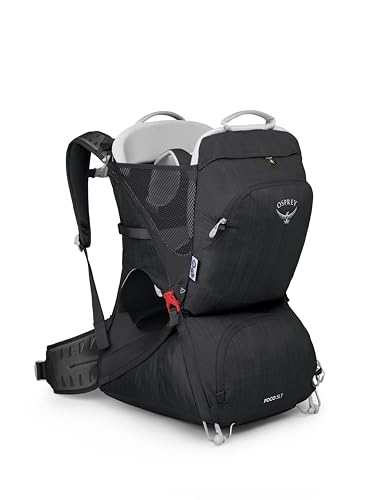
Osprey Poco LT
~5.1 lb
48.5 lb total
25 L
Included, in a zip pocket
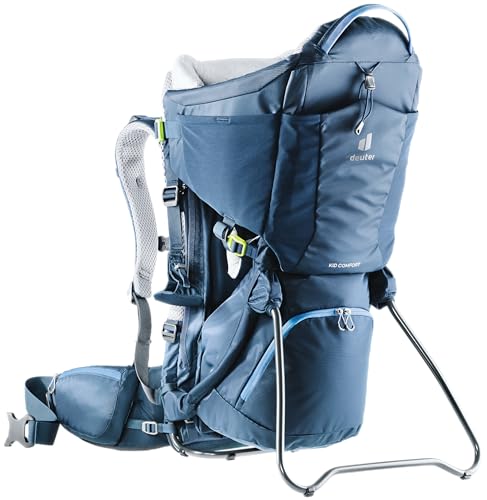
Deuter Kid Comfort
7.12 lb
40 lb child + 8 lb luggage
14 L
Included (removable Sun Roof)
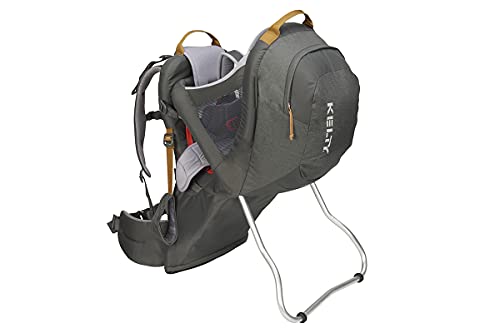
Kelty Journey PerfectFIT
6 lb 6 oz
48.5 lb total; child 16–40 lb
26 L
Not included on the base model
Osprey Poco SLT
4.72 lb
48.5 lb total
22 L
Sold separately, nowhere to stow it
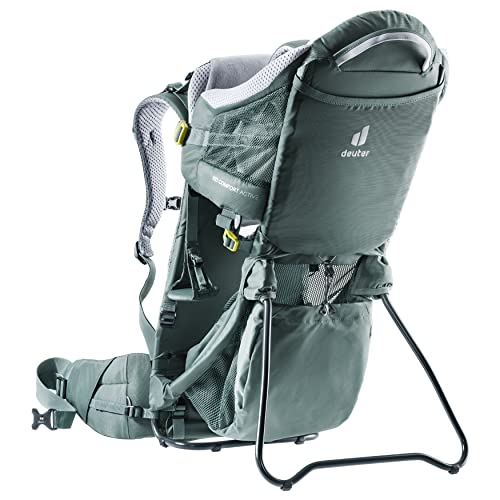
Deuter Kid Comfort Active
5.91 lb
20–49 lb recommended load
12 L
Not included (accessory)
Three things nobody tells you before the first hike
Load it and walk around the block before you commit to a trail.A framed carrier changes your center of gravity more than a loaded backpack does, because the weight is higher and it moves independently. Ten minutes on pavement tells you whether the hipbelt is in the right place and whether you have the shoulder straps anywhere near correct — and on the Osprey especially, those straps are hard to reach once the child is in.
The kickstand is not a chair. This is the lesson of the Deuter recall and it applies to every brand: a loaded carrier on its kickstand is stable until it is not, and a child strapped into a tipping frame has no way to protect their head. Load and unload on the ground, with the carrier leaning against something solid, and never leave a child unattended in one on its stand.
Dress the child for a parked car, not a hiking adult.You generate heat walking; the passenger does not. The child is sitting still, higher than you, in whatever wind there is. Hat, sunscreen on the parts the sunshade misses, and one more layer than you think — plus the knowledge that they will be asleep within forty minutes and sleeping people get cold.
Fitting it to the adult, which nobody does properly the first time
A framed carrier is fitted like a backpacking pack, not like a baby carrier, and almost everyone gets it wrong on the first outing because the instinct is to tighten the shoulder straps. The order that works:
Set the torso length with the carrier empty. This is the adjustment the Kelty publishes as 15.5 to 21 inches and Osprey publishes as six inches of travel on the Poco LT. Do it before the child is anywhere near it, because on every carrier here it is awkward or impossible to change once loaded. If two adults will carry, find both settings now and note them.
Put the hipbelt on the hip bones, not the waist. The top edge of the belt should sit roughly an inch above the top of your pelvis, so the padding wraps the bone rather than your soft middle. Tighten it before you touch anything else. This belt is carrying most of 35 to 40 pounds; if it is in the wrong place, your shoulders end up carrying it instead and you will know within a mile.
Then snug the shoulder straps, and stop short of tight.They are there to keep the frame against your back, not to hold the weight. On the Osprey in particular, reviewers keep flagging that these straps are hard to reach once the child is loaded — so set them roughly right while the carrier is empty and expect to make only small changes later.
Load the child on the ground and buckle their harness first. Then lift. Not the other way around, and never with the carrier balanced on its kickstand.
A useful rule of thumb for whether the fit is right: after ten minutes of walking, the dull ache should be in your hips and thighs. If it is in your shoulders or the base of your neck, the hipbelt is too loose or sitting too high, and no amount of shoulder-strap adjustment will fix it.
What the cargo volume is actually for
The 12-to-26-liter spread on this page only matters once you know what has to fit. For a half-day out with one child, the load that keeps coming back is: two liters of water for the adult plus something for the child, more snacks than seems sensible, a full change of clothes including socks, diapers and wipes in a dry bag, a sun hat and one warm layer for a passenger who is not generating heat, sunscreen, and a small first-aid kit. That is a genuine 15 to 20 liters before anything optional.
Which is why the Deuter Kid Comfort at 14 liters and the Kid Comfort Active at 12 are honestly described as one-adult-of-two carriers: they hold the child beautifully and expect somebody else to carry lunch. The Kelty at 26 liters and the Poco LT at 25 are the two that genuinely let one adult go out alone for a day. That is not a quality difference between the brands — it is a difference in what each one is for, and it is the spec most likely to decide which of these you should own.
Where this fits with the rest of your carrier kit
A framed carrier is a third carrier, not a first one. Most families end up with a soft structured carrier for daily life, a wrap or a stretchy for the newborn months, and eventually a frame for the long days out. Our best baby carriers page handles the daily driver, best baby carriers for newborns covers the first weeks, and best baby carriers for hot weatheris the relevant one if your hiking season is summer — mesh matters more in a soft carrier than in a frame, because the frame already has airflow behind the child. Before any of it, read babywearing safety: the TICKS rule and how to clean a baby carrier; a frame that has been on three muddy hikes needs the same attention as a soft one.
A framed pack is the right tool for a trail and the wrong one for a supermarket. For everyday toddler carrying — airports, theme parks, the school run — our best toddler carriers roundup ranks soft carriers with the published headroom to go past 35 lb alongside the lightest framed packs.
Quick picks at a glance
#
Product
Best for
Score
Price
1
Osprey Poco LT
The one framed carrier that ships with its sunshade stowed in a dedicated pocket, which is the difference between using one and leaving it at home.
The only carrier here built around the assumption that your child will fall asleep on the trail — and the line that CPSC recalled in 2025, so check the production code before you buy one secondhand.
A 15.5-to-21-inch torso range and a tool-free adjustment you can do on the trail — the carrier for a household where two people of different heights both carry.
Four and three-quarter pounds of carrier for the same 48.5 lb ceiling — the pound you save is a pound of child or water, as long as you accept that the sunshade is extra.
Deuter's slimmest frame, carried close to the back so it does not pendulum on a technical path — the same recalled line as the standard Kid Comfort, so check the code.
The only carrier here built around the assumption that your child will fall asleep on the trail — and the line that CPSC recalled in 2025, so check the production code before you buy one secondhand.
Maximum load
40 lb child plus 8 lb luggage — 48 lb total (Deuter)
Age guidance
From about 9 months (Deuter)
Carrier weight
7.12 lb (Deuter)
Volume
14 L
Sun roof
Removable sun canopy included on the current model
Warranty
Deuter lifetime repair service
Recall
CPSC 25-256, May 8 2025 — production codes ending 0123, 1223 or 0423 only
What we like
The side-entry opening and the height-adjustable child seat make loading a sleepy toddler a one-person job
Deuter's chin pad is the single best sleep feature in the category — a child's head rests on padding instead of falling forward
Removable sun canopy is included on the current model, not sold separately
Deuter's lifetime repair service is the longest support commitment of any brand here
The 40 lb child / 8 lb luggage split is published separately rather than buried in one combined number, which makes it much easier to plan around
Worth noting
CPSC recalled this line on 8 May 2025: the hinges on the foldable rear kickstand support leg can crack or break, posing a fall hazard when the carrier is set down. Affected production codes end 0123, 1223 or 0423 and were sold March 2023 to March 2025. Current production is not affected, but check the tag inside the bottom storage pocket before buying any used or old-stock unit
7.12 lb is the heaviest carrier on this page by more than two pounds
14 L of storage is barely a daypack — a full day out needs a second bag
Only 8 lb of luggage is allowed on top of the child, which is a real constraint once you add water for two people
No internal hydration reservoir sleeve on this model, which the Pro version has
A 15.5-to-21-inch torso range and a tool-free adjustment you can do on the trail — the carrier for a household where two people of different heights both carry.
Maximum total load
48.5 lb / 22 kg including child, gear and pack
Child weight
16 lb minimum, 40 lb maximum
Torso fit
15.5 in to 21 in
Carrier weight
6 lb 6 oz
Volume
26 L
Harness
5-point child harness
Sunshade
NOT included on the base PerfectFIT — Signature and Elite versions include one
What we like
The widest published torso range here, and the adjustment is tool-free — a real swap takes under a minute at a trailhead
26 L is the largest cargo volume on this page
Published child weight range is explicit at both ends (16 lb floor, 40 lb ceiling) rather than only a combined total
Five-point child harness rather than the three-point found on some competitors
Usually the cheapest framed carrier of this capacity that is actually in stock
Worth noting
No sunshade on the base PerfectFIT. Add one and the real price moves up toward the Osprey that includes it — this is the single most common buying mistake in the category
6 lb 6 oz puts it in the heavier half of the group
Kelty's own spec publishing is inconsistent; one community database lists 50 lb and 17 L against retailers' 48.5 lb and 26 L, so verify your unit's label
Availability is thin — our live check found a dozen units in the colorway we link, which is why the search fallback matters here
No chin pad, so a sleeping child's head is less supported than in the Deuter
Four and three-quarter pounds of carrier for the same 48.5 lb ceiling — the pound you save is a pound of child or water, as long as you accept that the sunshade is extra.
Maximum total load
48.5 lb including child, carrier and gear (Osprey)
Carrier weight
4.72 lb / 2.14 kg (Osprey)
Volume
22 L / 1,343 cu in (Osprey)
Child requirement
Must be able to sit up unassisted
Sunshade
Compatible but sold separately, and there is no pocket to stow it
Warranty
Osprey publishes a 7-year guarantee on the Poco line
What we like
Lightest framed carrier here at 4.72 lb — nearly two and a half pounds less than the Deuter
Same 48.5 lb total ceiling as the heavier Poco LT, so the weight you save becomes usable capacity
22 L is plenty for a half-day out with one child
Covered by the same Osprey 7-year guarantee as the rest of the Poco line
Cheapest Osprey in the line, by a clear margin
Worth noting
The sunshade is a separate purchase AND there is nowhere on the carrier to store it — owners report carrying it loose or leaving it behind. For a sun-exposed trail, buy the LT instead
Less torso adjustment and a simpler harness than the LT; sharing it between adults is more of a compromise
No child-cockpit extras — the LT's adjustable seat and stirrups are the reason it costs more
Smaller hipbelt pockets, which on a kid hike is where the snacks live
Fewer organization pockets overall; everything tends to end up in the main compartment
Deuter's slimmest frame, carried close to the back so it does not pendulum on a technical path — the same recalled line as the standard Kid Comfort, so check the code.
Recommended load
20–49 lb; Deuter publishes 22 kg child plus 2 kg luggage
Carrier weight
5.91 lb (Deuter)
Volume
12 L
Certification
Deuter states the TUV GS safety seal
Sun roof
NOT included — Deuter sells it as an accessory
Warranty
Deuter lifetime repair service
Recall
CPSC 25-256, May 8 2025 — production codes ending 0123, 1223 or 0423 only
What we like
Narrowest, closest-carrying frame on this page, which is what you want on a path with roots and rock steps rather than a fire road
A pound and a quarter lighter than the standard Kid Comfort for the same brand's suspension
Deuter states the TUV GS safety seal for this model, which is more third-party verification than any other carrier here publishes
An SL version is built on a women's-specific fit rather than a shortened unisex one
Lifetime repair service, like the rest of the Deuter line
Worth noting
Covered by the same CPSC recall as the standard Kid Comfort (25-256, 8 May 2025, kickstand hinge). Affected teal units have production codes ending 0423 or 1223 and were sold March 2023 to March 2025. Check the tag inside the bottom storage pocket on anything used or old stock
No sun roof in the box — it is an accessory, so budget for it the way you would on the Kelty
12 L is the smallest cargo volume on this page; this is a carrier plus a water bottle, not a day's kit
Deuter publishes the load as a 20–49 lb range in one place and 22 kg + 2 kg in another, which do not quite reconcile
Deuter's own listings for this model show it as discontinued in some regions, so availability is inconsistent
How it scored
Carry comfort8.8
Child comfort8.4
Sun & weather protection5.2
Storage5.8
Value8.0
Frequently asked questions
What is the best hiking baby carrier?+
The Osprey Poco LT, for one reason above all the others: its sunshade is included and stows in a dedicated zippered pocket on the carrier. Three of the five carriers here sell the sunshade separately, and the one on the Poco SLT has nowhere to be stored at all. The Poco LT also gives you 25 liters of cargo, six inches of torso adjustment and Osprey's seven-year guarantee on the Poco line.
At what age can a baby go in a framed hiking carrier?+
When they can sit up unassisted and hold their head steady without support — usually somewhere between six and nine months, and Deuter publishes 'from about 9 months' for the Kid Comfort. Before that a soft structured carrier or a wrap is the right tool: lighter, cheaper, closer to you and better at supporting a head that cannot yet support itself. A frame is for distance, not for newborns.
What is the weight limit on a hiking child carrier?+
Almost all of them publish around 48 to 48.5 lb, and the critical point is that this is a TOTAL — child plus carrier plus gear. A 7.12 lb Deuter Kid Comfort with six pounds of water and kit leaves roughly 35 lb for the child; a 4.72 lb Osprey Poco SLT with the same load leaves nearly 38 lb. Deuter is the one brand here that publishes the split explicitly, at 40 lb of child plus 8 lb of luggage.
Are Deuter Kid Comfort carriers recalled?+
Part of the line is. CPSC recall 25-256, announced 8 May 2025, covers Kid Comfort, Kid Comfort Pro and Kid Comfort Active units with production codes ending 0123, 1223 or 0423, sold March 2023 through March 2025 — about 5,080 units. The hinges on the foldable rear kickstand support leg can crack or break, posing a fall hazard when the carrier is set down. Current production is not affected. The production code is on a tag inside the main storage pocket at the bottom of the carrier; if it matches, stop using it and contact Deuter for a free replacement.
Do I need the sunshade?+
If you hike in sun, yes, and you should treat it as part of the price. The child sits higher than you, cannot move out of the sun, and cannot tell you they are burning. Only the Osprey Poco LT and the Deuter Kid Comfort include one. The Osprey Poco SLT, Deuter Kid Comfort Active and base Kelty Journey PerfectFIT all sell it separately, and SLT owners report there is nowhere on that carrier to stow it when it is not deployed.
Can two people share one hiking carrier?+
Yes, and the Kelty Journey PerfectFIT is the one built for it — 15.5 to 21 inches of torso fit, adjusted without tools. The Osprey Poco LT gives six inches of travel, which works for a moderate height gap, though reviewers note the range sits short for tall adults and the shoulder straps are awkward to reach once the child is loaded. If you plan to swap mid-hike, practice the adjustment at home first.
Is a framed carrier better than a soft carrier for hiking?+
Only past a certain distance and age. A frame puts the load on a real hipbelt, keeps the child cooler, carries your gear and lets a sleeping head rest on something — all of which matter on a four-hour day. Under about an hour, or with a baby who cannot yet sit unassisted, a soft structured carrier wins on weight, cost, closeness and simplicity. Most hiking families own both and use the soft one far more often.