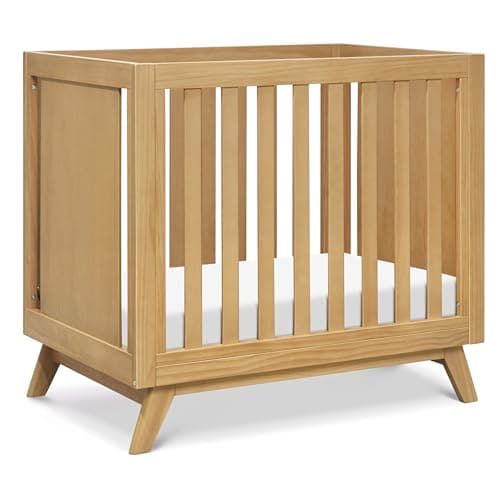
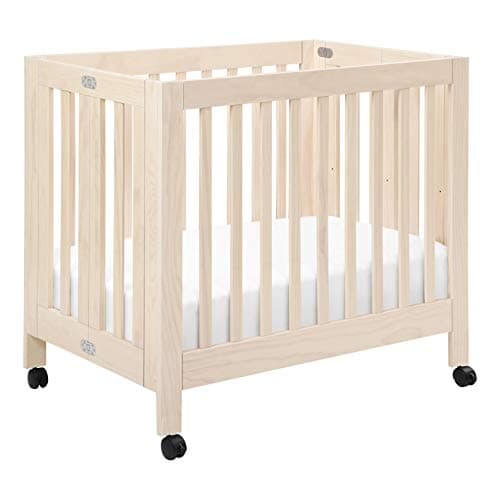
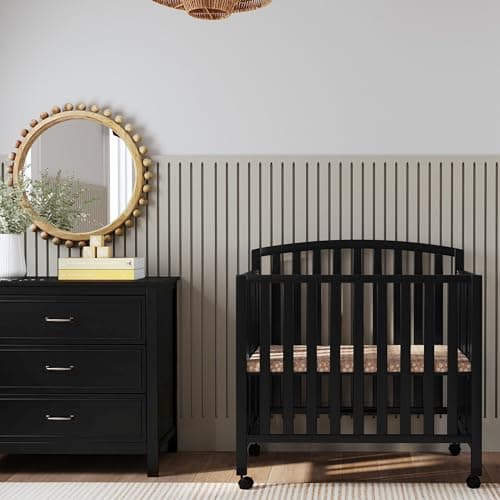
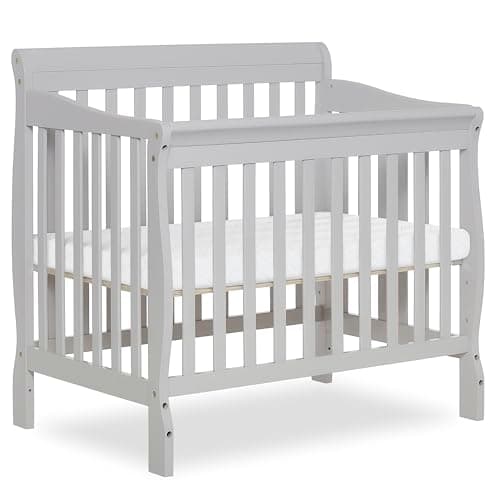
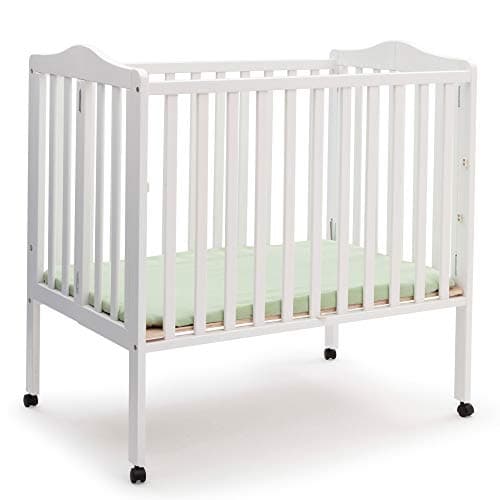
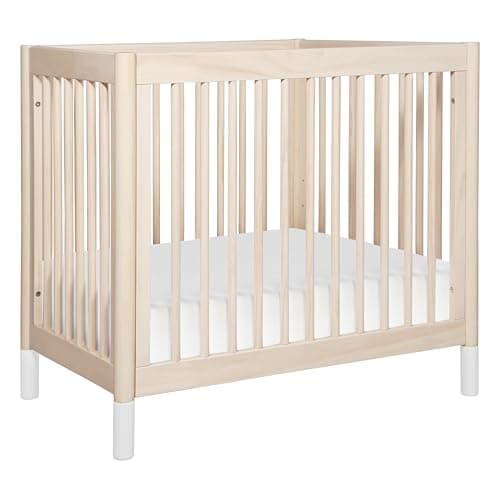
A mini crib is a shorter crib. That is the whole idea, and it is worth saying plainly because the name suggests something flimsier or more temporary than what you actually get. The six picks below are wooden cribs with fixed sides, adjustable mattress heights, and the same slat spacing rules as any other crib sold new in the United States — they are simply built around a sleep area of roughly 37 by 24 inches instead of a full-size one. If the nursery is a corner of your bedroom, a shared room, a city apartment, or a grandparent's spare room, that difference is the entire reason to buy one.
One thing does not change, and we will not soften it: the sleep surface has to be firm and flat, dressed with a fitted sheet made for that specific crib, and nothing else can be in it— no pillows, bumpers, loose blankets, positioners, or padded inserts. The baby sleeps alone, on their back, on that bare firm surface, every single sleep. That is the American Academy of Pediatrics safe-sleep guidance and the CPSC's position, and a smaller crib does not earn any exceptions to it.
Two companion pages take this further: Babyletto Gelato vs Hudson answers the mini-versus-full-size question with the brand held constant, and nursery furniture for small spaces puts a mini crib into a complete room.
A mini crib is a real crib — it just isn't a full-size one
"Mini crib" is marketing language. The regulatory term is non-full-size baby crib, and it has a federal safety standard of its own: 16 CFR Part 1220, which requires compliance with ASTM F406-24, the consumer safety specification for non-full-size baby cribs and play yards. The rule defines the category purely by measurement. A crib is non-full-size if its interior length is greater than 55 inches or smaller than 49 3/4 inches, or its interior width is greater than 30 5/8 inches or smaller than 25 3/8 inches. Everything that falls inside those two ranges is a full-size crib, covered by the separate full-size rule.
Run the picks below through that definition and something useful falls out. Every one of them has an interior sleep area of about 37 by 24 inches. The width is only about an inch and a half under the narrowest legal full-size crib. The length is nearly 13 inches shorter than the shortest full-size crib the standard allows. So a mini crib is not a scaled-down crib in both directions — it is a crib that gave up most of a foot of length and almost nothing in width. If your problem is a narrow wall, the gain is small. If your problem is a room where a 4-and-a-half-foot-long piece of furniture will not fit against any wall without blocking a door or a closet, a mini crib solves it outright.
That standard also tells you what a mini crib is not. Part 1220 excludes mesh-sided, net-sided, and other non-rigid products, along with cradles and bassinets. The soft-sided folding "travel crib" you may be picturing is a playard, and it plays by different rules — it uses only its own thin fitted pad and never an added mattress. We cover those separately in our best pack 'n plays and playards roundup. Our crib safety standards guide walks through the structural rules — banned drop sides, slats no more than 2 3/8 inches apart, no cutouts or raised corner posts — that apply to the rigid wooden cribs on this page too.
How to choose in one minute
- Want the mini crib that behaves most like a real crib? The Babyletto Gelato has four mattress heights, a 26-inch-wide footprint, and a conversion path that runs to a mini toddler bed and then a twin.
- Want to open one box and be finished? The DaVinci Otto is the only pick here that includes a genuine 4-inch mini crib mattress rather than a thin pad.
- Need the crib to disappear during the day? The Babyletto Origami folds flat, and its locking casters pop off for a slimmer fold.
- Want folding now and a real bed later? The DaVinci Dylan folds and converts to a twin, which no other pick here does, at roughly half the Origami's price.
- On a tight budget but want solid wood? The Dream On Me Aden is the cheapest full-featured wooden mini crib in this group, with three mattress heights and a twin conversion path.
- Setting up a second sleep space at another house? The Delta Children folding mini crib costs the least, weighs the least, and folds flat with its mattress stored inside.
What we weighed
We have not run these through a lab, and we will not pretend we have. The ranking comes from the published manufacturer specs and manuals, the federal standard the category sits under, what is actually in the box, and current prices — weighted with the rubric on our methodology page. Four things did most of the sorting.
- The footprint you actually save. These are not interchangeable. The Otto is the smallest at 38.5 by 25.5 inches; the Gelato is 39.75 by 26; the Origami is 39.25 by 25.75; the Dylan is 40.25 by 25.25. The Dream On Me Aden is 28 inches wide, which is more than two inches wider than most of this group and gives back a real slice of the benefit. Measure your wall before you fall in love with a finish.
- What mattress is in the box. This is the single most misread spec in the category. Only two of these six ship with something you can actually sleep a baby on: the Otto includes a 4-inch mattress, and the Delta includes a 1.5-inch one. The Gelato, Origami, Dylan, and Aden include a waterproof pad— one inch or less of cover material, not a sleep surface. If a listing says "mattress pad included," read that as "mattress not included" and add the cost.
- Mattress heights. The mattress support has to drop as your baby learns to sit and pull up, and more positions mean a gentler, longer-lasting fit. The Gelato, Otto, and Dylan give you four; the Aden gives three; the Origami and the Delta give two. Two positions is not unsafe, but the crib reaches its last usable setting sooner.
- Folding versus converting — pick one. These are two different bets. Folding buys you floor space today and portability between houses. Converting buys you years, turning the frame into a toddler bed or a twin. Only the Dylan does both. The Origami folds beautifully and converts to nothing; the Otto and Gelato convert well and do not fold at all.
Certification came last, because it sorts less than people expect. Five of these six are GREENGUARD Gold certified, which means the product was independently tested for low chemical emissions. That is genuinely reassuring for furniture in the room where your baby breathes all night, but it is an emissions certification, not a safety rating — it says nothing about structure. The Delta pick is also JPMA certified, a third-party program that verifies compliance with the applicable ASTM standard. Every crib sold new has to meet the federal standard regardless; these certifications are extras on top, and we note them only where the manufacturer publishes them.
The mattress question, in detail
Mini crib mattresses are their own size, and the size varies slightly by brand. The Otto ships with a 24-by-38-inch mattress; Babyletto specifies a 37-by-23.5-inch mattress for the Gelato and Origami; the Delta's included mattress measures 37.5 by 23.25 inches. Close, but not identical — which is exactly why you buy the mattress for your crib rather than assuming any "mini" mattress drops in.
The fit rule is the same as any crib: push the mattress firmly to one side, and you should not be able to fit more than two fingers between the mattress and the crib frame on any side. A larger gap is a genuine entrapment hazard. Never cut down a full-size crib mattress to fit a mini crib, and never stack a pad on top of a mattress to fill a gap — both create exactly the soft, uneven, shifting surface safe sleep rules exist to prevent. Thickness matters too: the Origami accepts a mini mattress up to 5 inches thick, and going thicker than a crib's manual allows reduces the effective rail height, which is what keeps a standing baby inside. Our best crib mattresses roundup explains the firm-and-snug rule in full; check your crib's manual for its own mattress limits before you order.
What a mini crib really costs
The sticker price is not the whole number, and mini cribs hide the extras better than most nursery furniture. Budget for three things: the crib, a mini crib mattress if one isn't included, and the conversion kit if you plan to convert. Kits are sold separately on every convertible pick here — the Otto's toddler kit, the Dylan's twin kit, both of the Gelato's, and all of the Aden's. A twin conversion also needs a twin mattress, which is a bigger line item than the kit.
Run that math before you decide a mini crib is the cheaper choice. The budget wooden picks land well under what a mid-range full-size convertible crib costs even after you add a mattress, so if space is the constraint, the money works. But a premium mini crib plus a mattress plus two conversion kits can land in the same bracket as a good full-size convertible crib that would have carried your child just as far. Buy a mini crib because the room demands it, not because you assume it saves money. Every price you see on this page is pulled live from Amazon and stamped with the date it was checked — where we can't verify one, we show a "check price" link rather than a stale number. If you're cost-cutting across the whole nursery, our baby gear on a budget guide is the better starting point.
When a mini crib is the wrong answer
If a full-size crib fits, buy the full-size crib. A four-in-one convertible costs about the same as a good mini crib, gives your child a foot more length to grow into, and converts to a toddler bed and often a full bed. Our best cribs roundup covers those. A mini crib is the right call when the room genuinely will not take one, not as a default.
If you want the baby at arm's reach for night feeds, you want a bassinet. The AAP recommends room-sharing for at least the first six months, and a bassinet is designed to sit beside your bed at that height. A mini crib can share a bedroom where a full-size crib cannot, which is a real advantage — but it is still a crib, not a bedside sleeper. See our best bassinets roundup, and bassinet vs. crib if you're deciding which to buy first.
If the need is travel and downstairs naps, buy a playard. A mesh-sided playard packs into a bag, sets up in a minute, and is built for exactly that job. A folding wooden mini crib folds flat but still weighs 29 to 50 pounds and does not fit in a car trunk the way a travel crib does. Our best pack 'n plays roundup covers those.
Safe sleep in a mini crib
Set the mattress at its highest position for a newborn, then lower it as soon as your baby can sit up or pull to stand — waiting until you see them do it once is waiting too long. Keep the crib bare: a fitted sheet made for that mattress and nothing more. Stop using any mini crib when your child can climb out, reaches the manufacturer's stated limit (DaVinci publishes 45 pounds for the Otto and Dylan; Babyletto publishes 45 pounds or 35 inches tall for the Origami), or is tall enough that the rail no longer contains them. Delta does not publish a weight limit for its folding crib, so with that one you are judging by height and climbing alone.
Two more habits worth building. Register the crib with the manufacturer so recall notices reach you, and check the CPSC recall list before buying any used or hand-me-down crib — the drop-side cribs that were banned in 2011 still circulate secondhand. And re-check every bolt after you move or fold the crib; folding frames get handled far more than stationary ones, and hardware that has been opened and closed a hundred times is worth a quarterly look.
What we left out, and why
Full-size convertible cribs. Different category, different page — they live in our best cribs roundup. Mesh-sided travel cribs and playards, because Part 1220 explicitly excludes non-rigid products and they follow different setup rules; they are in best pack 'n plays. Bassinets and bedside sleepers, which are excluded from the crib standard entirely and covered in best bassinets.
Two mini cribs that are genuinely fine were cut for a duller reason: they duplicate a pick we already made. The Dream On Me Edgewood is close enough to the Aden from the same maker that featuring both would be padding a list rather than widening a choice, and the second DaVinci Dylan listing — the non-folding portable version — is the same crib without the feature that earned its place. We also passed on Dream On Me's older mini folding 3-in-1 crib: when we checked availability it showed only a handful of units in stock, and thin stock on a crib is a bad thing to send a reader toward.
The quick-picks table below shows a live price for each crib and links to the full write-up. If you're still building out the room, our best nursery dressers roundup covers storage and the changing station in a small nursery, the nursery setup checklist ties the safe-sleep basics together, and how to choose a crib walks through the decision from the top.