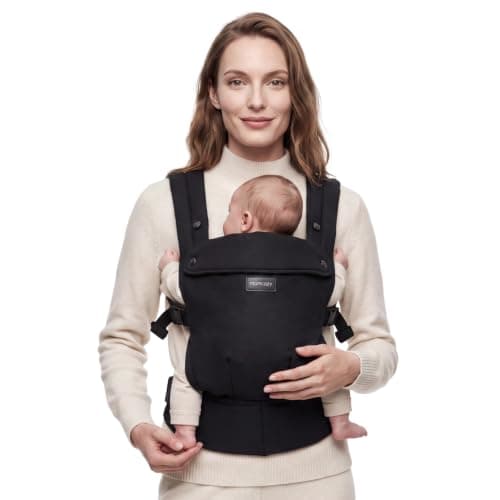
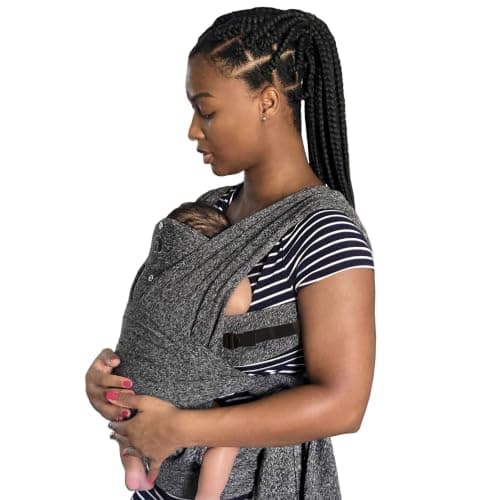
Quick verdict: choose the Momcozy Ergonomic Carrier if you want a light, breathable structured carrier that buckles on the same way every time and keeps working well into the toddler years; choose the Boppy ComfyFit Hybrid Carrierif you want the snug, body-hugging closeness of a wrap with none of the tying, in the softest and most forgiving package for a first-time babywearer. Both hold a baby in a hip-healthy seat, both are genuinely affordable, and neither asks you to learn the fabric-origami of a traditional wrap—so this is less about which is "better" and more about the feel you want against your body and how long you need the carrier to last.
We have not put either carrier through a hands-on lab test—we rank from each maker's published specifications, widely documented product facts, and our methodology—so treat this as a spec-and-design comparison, not a wear-tested review. If you want to see the whole field first, our best baby carriers roundup ranks every style; this page is the head-to-head for the two carriers parents most often cross-shop when they want easy and affordable over premium and structured.
Structured vs hybrid: two different feels
The Momcozy is a structured carrier: a defined panel, padded shoulder straps, and a wide padded waistband that buckles around your hips so the weight of your baby rides low on your pelvis rather than pulling on your shoulders. You clip the waistband, seat the baby, pull the panel up, and buckle the shoulders—the same routine every time. The Boppy ComfyFit is a hybrid: it wraps soft, stretchy panels around your torso for the close, cocooned feel of a wrap, but it fastens with a buckle at the waist instead of a long tie, so there is no wrapping and no knot to get right. In practice the Momcozy feels more like a supportive, adjustable pack you put on, while the Boppy feels more like a stretchy layer that molds around both of you. Neither feel is universally better: some parents love how the Boppy disappears against the body, while others want the firmer, load-bearing waistband of a structured carrier. If you already know you prefer a snug wrap-like hug, lean Boppy; if you want defined support you can dial in with straps, lean Momcozy.
Carry positions and how long each lasts
This is the clearest split on the spec sheet. The Momcozy carries three ways—front inward, front outward, and back—and is rated for roughly 7 to 45 lb. The Boppy ComfyFit carries two ways—front inward and front outward—and is rated for roughly 8 to 35 lb, with no back-carry or hip position. Two things follow from that. First, the Momcozy's back carry and higher weight ceiling mean it keeps earning its place well into toddlerhood, when a heavier child on your front starts to feel like a lot and a back carry becomes the comfortable option. Second, the Boppy tops out sooner and stays a front carrier, which makes it best as a newborn-and-infant snuggler rather than a carry-them-till-they-walk workhorse. A note on the face-out position both offer: only turn a baby to face outward once they have strong, steady head and neck control, and keep those outward sessions short—facing out is stimulating and gives no place to rest a sleepy head. For most of the early months, facing in is the comfortable, restful default in either carrier.
Ease of learning and putting it on
Both of these are, by design, easy carriers—that is the whole point of picking them over a premium structured model or a traditional wrap. The Boppy has the gentler on-ramp for an absolute beginner: you buckle the waist, slip the stretchy panels over each shoulder, and settle the baby into the pocket, which gives you wrap-like closeness without ever learning to wrap. Many new parents find that reassuring in the newborn fog. The Momcozy is not far behind; the buckle routine is quick once you have set the strap lengths for your body, and because it is structured, every put-on feels the same and stays consistent between two caregivers of different sizes. Where the Boppy's stretchy panels can take a beat to arrange so the baby sits snug and centered, the Momcozy's panel and buckles give you a more repeatable, adjust-once fit. If the person most nervous about babywearing is the deciding factor, the Boppy's soft simplicity is hard to beat; if two caregivers will share the carrier and want a fast, identical setup each time, the Momcozy's buckles are the friendlier system.
A hip-healthy seat and safe newborn positioning
Whatever you choose, the way the baby sits matters more than the badge on the strap. For hips, the International Hip Dysplasia Institute recommends a carrier that supports the thighs all the way from knee to knee so the legs fall into a spread-squat "M" shape—knees higher than the bottom, thighs supported, rather than the legs dangling straight down from the crotch. Both of these carriers are built to seat a baby that way when the baby faces inward, with the fabric spread across the thighs to the backs of the knees. This supports healthy positioning; it does not treat or prevent any medical condition, and no carrier should be described as medically necessary. For the airway, the rules are the same in a structured carrier or a hybrid: keep a newborn high and upright on your chest, close enough to kiss, with the face turned to the side and visible at all times and the chin off the chest so there is a finger's width of space under it and the airway stays open. Curling a small baby into a chin-to-chest "C" can restrict breathing, so check the position often, especially if the baby has fallen asleep. Confirm your carrier's manual for how it recommends seating the smallest babies—some carriers position a newborn legs-in or use an insert—and follow those instructions to keep the baby high, upright, and easy to see.
Breathability, comfort for longer wears, and value
For comfort over an hour-long walk or a fussy afternoon, two things drive how each feels. The Momcozy uses a breathable, lightweight fabric and a wide padded waistband, so it vents reasonably well and spreads a growing baby's weight onto your hips—the combination that makes it a comfortable daily driver as the baby gets heavier. Its honest trade-offs are a less refined finish than premium brands and no dedicated hip-carry position. The Boppy leans on a soft, stretchy blend that hugs closely and feels lovely and cozy, but that same wrap of stretchy fabric layered around your torso can feel warmer in hot weather, and without a firm structured waistband some parents notice more of the load on their shoulders as the baby approaches that 35 lb ceiling. On value, both are firmly in the affordable, easy-carrier bracket rather than the premium tier; we do not quote figures because live prices show on the cards above and move over time. Put plainly: the Momcozy is the better value if you want one carrier to last from the newborn stage through a busy toddler, in the heat, with a back-carry option in reserve; the Boppy is the better value if closeness and softness in the early months matter more to you than longevity or a back carry, and you want the simplest possible thing to put on.
Both of these carriers do the core job honestly—an affordable, easy way to hold your baby in a hip-healthy seat without a premium price or a steep learning curve—so there is no wrong answer, only the match to your comfort and your stage. Reach for the Momcozy if you want a structured, breathable everyday carrier that grows with your child; reach for the Boppy ComfyFit if you want the wrap-like hug in the gentlest, simplest form for the newborn months. If you are still weighing styles beyond these two, our guide on how to choose a baby carrierwalks you through matching a carrier to your body, your climate, and your baby's stage.