A nursery dresser is judged on three things nobody puts on the box: whether it tips, whether its top works as a changing station, and whether it survives the nursery years.
Disclosure:Swaddle & Stroll is reader-supported. When you buy through links on this page we may earn an affiliate commission, at no extra cost to you. It never changes our picks. How this works.
Buy for stability first, changing-top depth second, and drawer count third — and anchor whatever you buy to the wall before anything goes in the drawers. Every clothing storage unit sold in the US now has to pass a federal tip-over test, so stability is not something you pay extra for; what you are checking is whether the design goes further than the minimum, and whether the anchor kit is in the box. Then the practical question: a dresser whose top takes a changing pad saves you buying a changing table at all.
A dresser is also the piece of nursery furniture most likely to still be in the house in ten years, so it is worth a few minutes of thought. Here is the order we would think in.
1. Will the top work as a changing station?
This is the decision that saves the most money, because a dresser that doubles as a changing station means not buying a changing table. Three things have to be true:
Depth.A standard contoured changing pad is roughly 16 to 17 inches deep. A dresser top around 19 to 20 inches deep holds one with the pad's safety strap anchored and a margin behind. A shallow modern dresser does not.
Height. You want the pad surface near your waist. Too low and you will change the baby on the floor instead; too high and you will be lifting a toddler above your chest.
A way to fix the pad down. Either a removable changing tray designed for that dresser, or a pad with a non-slip base and a strap you can screw into the top. A pad sitting loose on a smooth dresser top is the wrong setup.
Whatever you use, the rule is the same one that applies to a changing table: never step away from a baby on the pad, and keep the strap fastened. If you would rather have a dedicated piece of furniture, our best changing tables roundup and how to choose a changing table cover that route.
2. How many drawers does the room have space for?
Six-drawer dressers hold a nursery's whole wardrobe plus blankets and spare sheets, and the wide ones double as the changing surface. They also need 45 to 50 inches of wall. Three-drawer dressers fit a tight nursery or a narrow wall — a compact one runs about 35 inches wide and 20 deep — and still take a changing pad, but you will be doing laundry more often or storing clothes elsewhere.
Measure the wall andthe clearance in front, because a drawer needs about 20 inches to open fully. In a small nursery that clearance, not the dresser's width, is usually what rules a piece out.
3. What the materials actually tell you
GREENGUARD Goldis the certification worth looking for, and it is not about strength — it certifies low chemical emissions, which matters because engineered wood and finishes off-gas in a small, closed room where a baby sleeps. Most mainstream nursery dressers carry it at every price point, including the budget ones.
Engineered wood versus solid hardwood is a durability and weight question, not a safety one. Composite construction is what makes a dresser affordable; it is heavier than it looks, holds screws less well over repeated disassembly, and will not survive three house moves as gracefully. If you expect to move the dresser between rooms and homes, pay for solid wood; if it is going to sit against one wall for a decade, do not.
Drawer glides are the thing you will notice daily. Metal glides with a soft stop beat plastic runners by a wide margin, and a drawer you can open one-handed while holding a baby is worth more than an extra drawer you cannot.
4. The five checks before you buy
Does it ship with a wall-anchor kit, and does the listing confirm it meets the STURDY / ASTM F2057 stability rule?
Is the top at least about 19 inches deep, if you want it as a changing station?
Do you have the wall width and about 20 inches of clearance in front?
Is it GREENGUARD Gold certified, given it lives in the room where your baby sleeps?
Is the finish wipeable? Everything in a nursery gets wiped.
Three dressers that answer the three cases
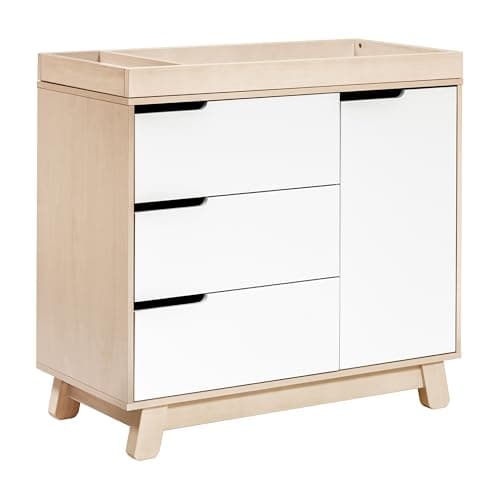
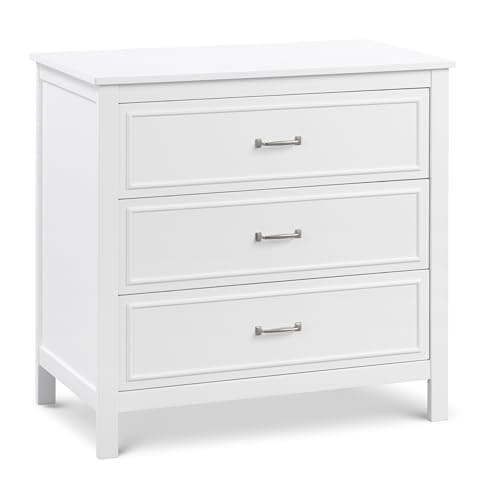
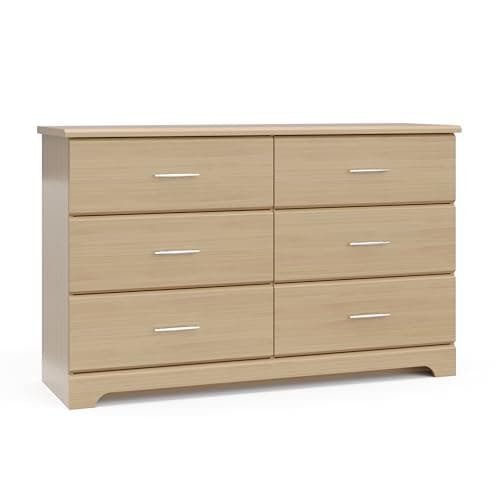
Below are the picks that match the three situations above: the wide six-drawer dresser with a changing-pad-ready top, the design-led dresser with a removable changing tray, and the compact three-drawer dresser for a tight room. The full ranking, including the budget and the grow-into-a-big-kid-room options, is in best nursery dressers, and if you are furnishing the whole room cheaply, best budget nursery furniture has the value pick in every category.
Quick picks at a glance
#
Product
Best for
Score
Price
1
Storkcraft Brookside 6-Drawer Dresser
A roomy, GREENGUARD Gold six-drawer dresser with a wide top that doubles as a changing surface — the sensible middle-ground pick for most nurseries.
A compact three-drawer dresser — about 35 inches wide and only 20 deep — that fits a tight nursery or a narrow wall without giving up drawer space.
Drawers
3
Size
About 35" W x 20" D — compact footprint
Top
Holds a standard changing pad
Finish
Several color options
What we like
Small footprint fits tight rooms and narrow walls
Lower price than full-size dressers
Top is sized for a changing pad
Worth noting
Three drawers hold less than a six-drawer chest
Composite construction
How it scored
Space efficiency9.2
Stability & safety8.6
Build quality8.0
Value8.8
Frequently asked questions
Can you use a regular dresser as a changing table?+
Yes, if the top is deep enough for a contoured changing pad — about 19 to 20 inches — the height suits you, and you can fix the pad down with a non-slip base or a strap screwed into the top. Anchor the dresser to the wall first, keep the pad's safety strap fastened, and never step away from the baby.
Do nursery dressers have to meet an anti-tip standard?+
Yes. The federal STURDY Act led the CPSC to adopt ASTM F2057 as a mandatory stability standard for clothing storage units, so every dresser sold in the US has to pass a tip-over test. The standard assumes the unit is anchored to the wall, which is why the anchor kit in the box is part of the safety design rather than an accessory.
What does GREENGUARD Gold certification mean on a dresser?+
It certifies low chemical emissions — the furniture has been tested for the VOCs it releases into the air. It says nothing about strength or stability. It matters in a nursery because engineered wood and finishes off-gas in a small, closed room where a baby sleeps for most of the day.
How many drawers does a nursery dresser need?+
Six drawers hold a full nursery wardrobe plus blankets and spare sheets but need 45 to 50 inches of wall. Three drawers fit a narrow wall, run about 35 inches wide, and still take a changing pad. Measure the clearance in front too — a drawer needs roughly 20 inches to open fully, and in a small nursery that is usually the binding constraint.
Is engineered wood safe for a nursery?+
Yes, and it is what makes most nursery dressers affordable. The thing to check is emissions rather than the material itself — a GREENGUARD Gold certified composite dresser has been tested for what it releases into the room. Solid hardwood buys durability through moves and reassembly, not safety.