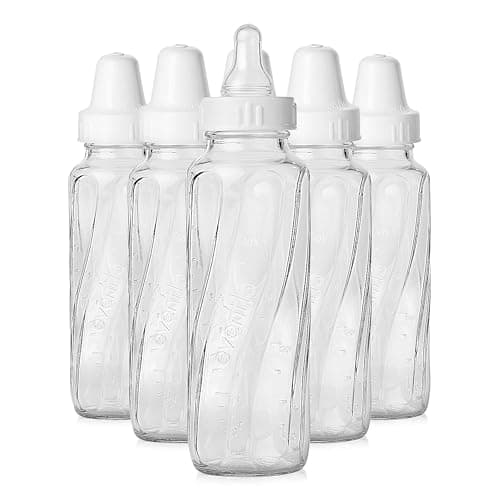
Five bottles ranked on the three things that decide whether feeding goes well: how the air gets out, how the nipple paces the feed, and how many pieces you wash at 3 a.m.
Disclosure:Swaddle & Stroll is reader-supported. When you buy through links on this page we may earn an affiliate commission, at no extra cost to you. It never changes our picks. How this works.
If your baby is gassy, start with Dr. Brown's Anti-Colic Options+. Its internal vent routes air down a tube and out at the collar rather than letting it bubble through the milk, and it is the only widely sold design where you can see the mechanism doing something. The price is washing up: five pieces per bottle, including a vent tube that needs its own brush. If your baby feeds fine and what you want is your evening back, the Comotomo is two parts with an opening wide enough to clean by hand. And if your baby goes between breast and bottle, the Philips Avent Natural Response nipple — which releases milk only when the baby actively drinks — is the one feature on this page most likely to prevent a bottle refusal.
Per how we pick: we have not lab-measured flow rates and we make no claim to have. Every figure below comes from the maker, the product listing or a named retailer spec sheet, cited at the bottom, and where a manufacturer makes a clinical claim we could not trace to a published study, we say exactly that rather than repeating it as fact.
The BPA baseline: “BPA-free” is the law, not a feature
Every bottle marketing page in America shouts “BPA-free.” Here is the thing worth knowing: the FDA amended its food-additive regulations in July 2012 to no longer provide for the use of BPA-based polycarbonate resins in infant feeding bottles and sippy cups. A baby bottle legally sold in the US is not made of BPA polycarbonate. So “BPA-free” on a new bottle tells you the manufacturer is complying with a fourteen-year-old rule, which is not a reason to pick one bottle over another.
What is worth reading on a label: whether the brand also names BPS, phthalates and PVC (several here do), and whether the material is glass, silicone or polypropylene. Those are real differences and they are covered below.
What actually separates bottles
How the air gets out. A baby sucking milk out of a sealed bottle creates a vacuum, and air has to get back in. Where it goes in is the whole anti-colic question. The weakest design lets air bubble up through the milk. A vented nipple lets air in around the nipple base. A valve, like Avent's, keeps air on the far side of the nipple. A vent tube, like Dr. Brown's, carries air to the back of the bottle without it passing through the milk at all. More mechanism means less air swallowed and more parts to wash — there is no version of this trade that does not exist.
Whether the nipple paces the feed. A plain nipple plus gravity means milk arrives whether the baby is working for it or not, which is why bottle-fed babies sometimes drain four ounces in three minutes and then look miserable. A nipple that only flows on an active suck hands the pace back to the baby. Avent builds this into the Natural Response nipple; it is the single most useful feature here for a baby who also breastfeeds.
Parts count, which is the real daily cost.Count the pieces, then multiply by six to ten feeds a day. Comotomo is two. Evenflo's glass bottles are three. Dr. Brown's with the vent in is five. Over a year that difference is measured in hours at the sink. Our sterilizing guide covers what you actually have to do to each of them.
Neck width, which decides what else fits.A narrow neck fits almost every warmer, sterilizer rack, brush and car cup holder. A wide neck is easier to clean by hand and holds a breast-shaped nipple, but Comotomo's wide base in particular will not fit many warmers. Check this before you buy a warmer, not after.
Material.Glass does not scratch, cloud, stain or hold smells, and takes boiling without complaint — it is also heavy and breaks. Silicone is soft, unbreakable and the easiest to clean. Polypropylene is light and cheap and degrades visibly over a year of hot washes. The Chicco Duo is a genuine attempt to split the difference: a micro-thin glass layer bonded inside a plastic bottle, so milk only ever touches glass.
How the five compare
Bottle
Air handling
Parts per bottle
Material
In the pack
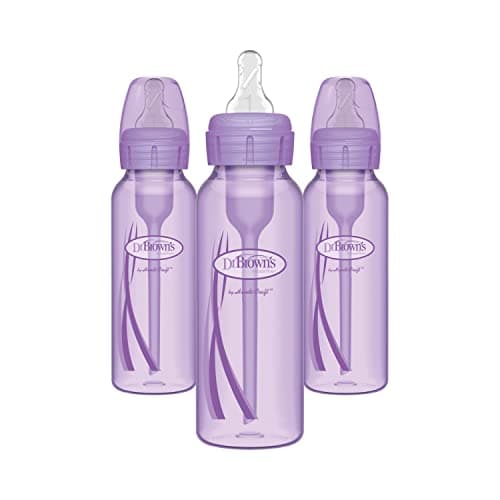
Dr. Brown's Options+ Narrow
Internal vent tube, removable
5 with the vent, 3 without
Polypropylene
3 x 8 oz
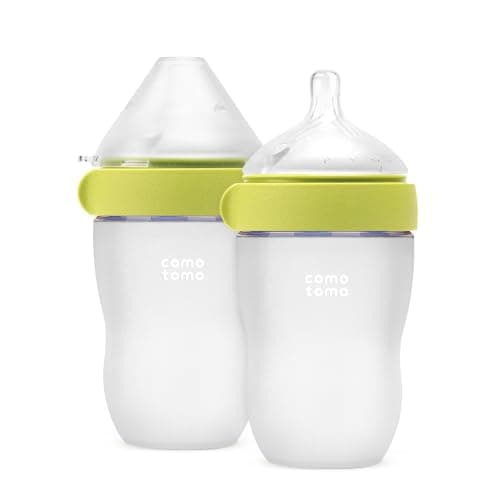
Comotomo Gen 2
Two vents in the nipple
2
Silicone
2 x 8 oz
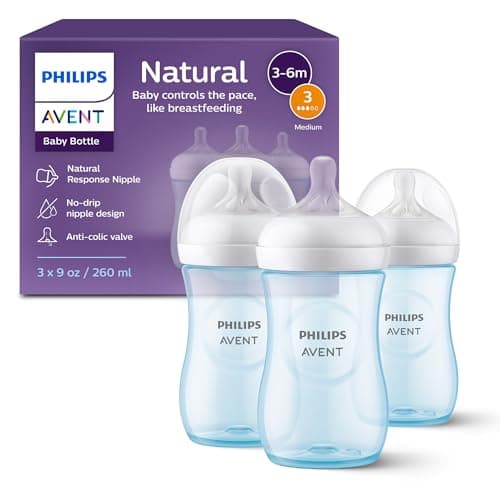
Avent Natural Response
Valve; flows only on an active suck
3
Polypropylene
3 x 9 oz
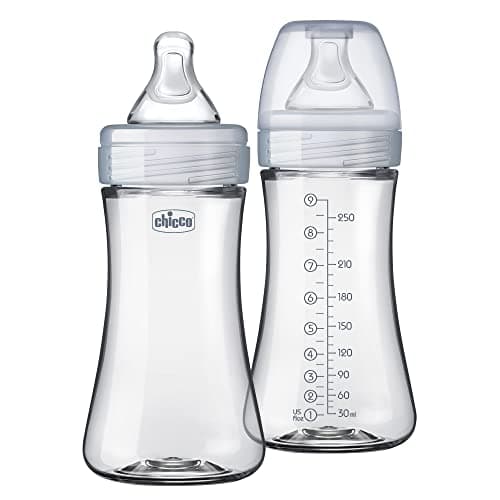
Chicco Duo Hybrid
Anti-colic Intui-Latch nipple
3
Glass bonded inside plastic
2 x 9 oz
Evenflo Classic Glass
Vented nipple only
3
Tempered glass
6 x 8 oz
Read the parts column as the price of the air column. The bottle with the best venting has the most pieces; the bottle with the fewest pieces has the lightest venting. Nobody has solved that, and a brand claiming to has usually just moved the vent somewhere you cannot brush.
Nipple flow is the thing people get wrong
Most bottle problems that get blamed on the bottle are nipple-flow problems. Two useful, published rules:
Philips' own sizing test:if the baby takes longer than 20 minutes to drink 50 mL (1.7 oz), move to the slower First Flow nipple. Philips also says to go faster if the baby struggles to get milk out or starts playing with the nipple, and slower if milk leaks from the mouth or the baby gulps.
Dr. Brown's published flow steps: Level 2 flows 60% faster than Level 1, and Level 3 flows 50% faster than Level 2. Those are big jumps. A baby who coughs, sputters or gulps on a new nipple is almost always on too fast a flow, not too slow a one.
The default mistake is going up too early because a feed feels slow. A slow feed is often the point. Twenty to thirty minutes for a bottle is normal and healthy; three minutes is not.
Glass, silicone, plastic or hybrid?
Glass is the cleanest material and the best value if you can live with the weight. It does not scratch, cloud, absorb smells or degrade, and tempered glass takes repeated boiling. Six Evenflo glass bottles cost about what two or three of anything else here cost. It is also heavy, it breaks on tile, and it is not the bottle to send to daycare or hand to a nine-month-old who wants to hold it.
Siliconewins on cleaning and on feel. Comotomo's squeezable body is the closest thing here to skin, which is why it is the bottle most often recommended for a baby refusing rigid bottles, and the two-part construction means nothing can be reassembled wrong. The costs are price, a wide base that will not fit many warmers, and the fact that Gen 2 nipples do not fit Gen 1 bottles — so inherited Comotomo parts may be useless.
Polypropylene is the default for a reason: light, cheap, unbreakable, available everywhere, and the material every vent-tube and valve system was designed around. It also visibly ages. After a year of hot washes a plastic bottle is cloudier and more scratched than a glass one, and scratches are where biofilm lives.
The hybrid— Chicco's Duo — is the most interesting idea in the category: a micro-thin glass layer permanently bonded inside a plastic bottle, so milk only touches glass while the bottle handles like plastic. We like the idea and we have to report the failure mode honestly: owner reviews include the plastic outer shrinking or cracking after sterilizing, and when a bonded two-material bottle fails that way there is no replaceable part. Follow the care instructions exactly and do not improvise with boiling water.
How many bottles do you actually need?
Fewer than most registries suggest, and it depends entirely on whether you are exclusively bottle-feeding or topping up. The short version: an exclusively bottle-fed newborn runs through eight to ten feeds a day, so you want enough bottles to get through a day without washing mid-afternoon; a combination-fed baby may need three or four total. We worked the arithmetic through properly in how many bottles do you need, which is the page to read before you buy a six-pack of anything.
A related warning worth repeating: do not buy eight bottles of one brand before the baby arrives.Bottle preference is the least predictable thing about a newborn, and the standard advice — buy one or two of two different shapes, then buy the winner in bulk — exists because it is right. Our registry mistakes page has this at the top of the list.
Who should buy which
Gassy, refluxy, or colicky baby:Dr. Brown's Options+. The vent tube is the real mechanism, it comes out when you no longer need it, and replacement parts are easy to find years later. Accept the washing up.
You want the least work: Comotomo Gen 2. Two parts, hand-cleanable, soft silicone. Check that your warmer takes a wide base, and do not assume older Comotomo nipples will fit.
Breast and bottle together: Avent Natural Response. The valve hands pacing back to the baby, which is the thing most likely to prevent a bottle refusal. Expect slower feeds, by design.
You want glass but not glass weight: Chicco Duo. Milk touches only glass; the bottle handles like plastic. Follow the care instructions to the letter.
Budget, or you just want glass: Evenflo Classic Glass. Six bottles for the price of two of most rivals, three simple parts, nothing to degrade. Not for daycare, not for a baby holding their own bottle.
What we left out, and why
Tommee Tippee Natural Startcame close and did not make the five. It is well made, the breast-shaped nipple is good, and it is priced between the Avent and the Evenflo — but on our criteria it does not win a column. Its venting is a nipple-level anti-colic valve rather than a vent tube, its nipple does not gate flow on an active suck, and it is a three-part polypropylene bottle. If you already own them, there is no reason to switch. We would not buy them over the Avent for a breastfed baby or over the Dr. Brown's for a gassy one.
We left out the self-sterilizing and app-connected bottles for the same reason we left smart high chairs off our high chair picks: the feature does not survive the parts-count test, and no amount of telemetry changes how a baby feeds. We also left out bottle systems sold primarily as pump accessories. If you are pumping, the bottle that matters is the one that screws onto your pump, and that decision belongs with the pump — see how to choose a breast pump.
Finally, we did not rank on owner star ratings. They are useful for spotting a failure mode — that is exactly how the Chicco Duo's sterilizing problem surfaced in our cons list — but an average across colorways and pack sizes says nothing about whether a nipple suits your baby, which is the only thing that really decides a bottle.
Dr. Brown's Anti-Colic Options+ Narrow, 8 oz (3-pack)
The internal vent routes air down a tube and out of the collar instead of through the milk — the most mechanically convincing anti-colic design sold, and the most parts to wash.
The nipple only releases milk when the baby actively drinks, which is the closest a bottle gets to letting the baby set the pace rather than gravity setting it.
Tempered glass, a slow-flow vented nipple and six bottles for the price of two of anything else here — the unglamorous answer that has worked for decades.
Dr. Brown's Anti-Colic Options+ Narrow, 8 oz (3-pack)
8.8★★★★★
The internal vent routes air down a tube and out of the collar instead of through the milk — the most mechanically convincing anti-colic design sold, and the most parts to wash.
Capacity
8 oz / 250 mL, three bottles
Vent
Internal vent tube; air enters at the collar and bypasses the milk
Vent removable
Yes — Dr. Brown's states the bottle works without it as the baby grows
Nipple
Level 1 slow flow, 0m+, silicone; fits every Dr. Brown's narrow bottle
Flow steps
Level 2 is 60% faster than Level 1; Level 3 is 50% faster than Level 2
Replacement parts
Dr. Brown's sells a narrow replacement vent kit
What we like
The vent is a real mechanism, not a marketing valve: air travels a tube and leaves at the collar rather than passing through the milk
The vent comes out when you no longer want it, turning a five-part bottle into a three-part one
Flow steps between nipple levels are published as percentages, so stepping up is a measured decision
Narrow neck fits almost every bottle warmer, sterilizer rack and diaper-bag pocket
Replacement vents and nipples are easy to buy years later, which is rarer than it should be
Worth noting
Most parts to wash of any bottle here, and the vent tube needs the little brush every time
Dr. Brown's “clinically proven to reduce colic” claim is repeated by every retailer, but we could not trace the underlying study, so treat it as a manufacturer claim
The vent can leak if the collar is over-tightened or the parts are assembled slightly wrong
A narrow nipple is a harder sell to a baby who is used to a wide breast-shaped one
Five pieces per bottle times eight bottles a day is a real amount of washing up
The nipple only releases milk when the baby actively drinks, which is the closest a bottle gets to letting the baby set the pace rather than gravity setting it.
Capacity
9 oz, three bottles
Nipple
Natural Response — the opening releases milk only when the baby actively drinks
Drip
No-drip design (Philips)
Anti-colic
Valve designed to keep air away from the baby's stomach
Flow range
Philips publishes five Natural Response flow rates plus a First Flow nipple
Sizing guidance
Philips: move to First Flow if the baby takes over 20 minutes to drink 50 mL (1.7 oz)
What we like
Pace is set by the baby's suck rather than by gravity, which is the single best feature for a breastfed baby who also takes bottles
No-drip means a bottle you can hand over, tip and carry without losing milk
Philips publishes an actual sizing rule — over 20 minutes for 50 mL means go down a flow, not up
Wide, soft, breast-shaped nipple with a flexible base
Five flow steps plus a First Flow, so the nipple can follow the baby for a year without changing brands
Worth noting
The valve means a slower, more effortful feed by design — a hungry, impatient baby may fight it at first
Philips renumbered its flow rates, so older nipples and newer bottles are confusing to match
Wide neck does not fit narrow-neck warmers and sterilizer racks
The anti-air claim is a valve, not a vent tube — it is a lighter mechanism than Dr. Brown's
The separately sold AirFree vent is a different product line; this bottle does not include it
A micro-thin glass layer bonded inside a plastic bottle, so milk only ever touches glass while the bottle keeps plastic's weight and drop tolerance.
Capacity
9 oz, two bottles
Construction
Invinci-Glass layer permanently bonded inside a plastic outer bottle
Nipple
Intui-Latch silicone, Stage 1 slow flow
Materials
Listings state BPA-, BPS-, PVC- and phthalate-free; made in the USA
Care
Listed as dishwasher, bottle-warmer and electric-sterilizer safe
What we like
Milk touches glass, not plastic — the real reason people buy glass bottles
Weighs and drops like plastic, which is the real reason people give glass bottles up
Nipple is designed for latch retention and has a skin-like texture rather than a slick one
Made in the USA, which is unusual in this category and verifiable on the listing
Rated for the dishwasher, a warmer and an electric sterilizer, so it fits an ordinary kitchen routine
Worth noting
Owner reviews include reports of the plastic outer shrinking or cracking after sterilizing — the one failure mode a bonded two-material bottle has that a single-material bottle does not
If the outer plastic does crack, the bottle is finished; there is no replaceable part
More expensive per bottle than plain glass or plain plastic
Only two bottles in the pack, where the plastic options give you three or six
Chicco does not publish an independent spec sheet we could read; the construction details come from retailer listings
Tempered glass, a slow-flow vented nipple and six bottles for the price of two of anything else here — the unglamorous answer that has worked for decades.
Capacity
8 oz, six bottles
Material
Tempered glass
Nipple
Slow-flow vented silicone nipples included
Parts
Three: bottle, nipple, ring
Note
US baby bottles cannot use BPA-based polycarbonate — see 'the BPA baseline' on this page
What we like
Six bottles for the cost of two or three of most rivals, which is what a full day of feeds actually needs
Glass does not scratch, cloud, stain or hold smells the way plastic does after months of washing
Three simple parts, all easy to clean and all cheap to replace
Tempered glass takes boiling-water sterilizing without a second thought
Fits standard narrow-neck warmers, brushes and sterilizer racks
Worth noting
It is glass: heavier than every other bottle here, and it will break if it hits a tile floor
Glass is the wrong bottle for a baby holding it themselves, and the wrong bottle for a daycare bag
Anti-colic is just a vented nipple — no vent tube, no pacing valve
Narrow standard nipple shape is the hardest transition for an exclusively breastfed baby
No silicone sleeves included, which most glass-bottle buyers end up adding
How it scored
Anti-colic design6.4
Ease of cleaning9.2
Nipple & latch7.0
Durability7.0
Value9.8
Frequently asked questions
What is the best baby bottle for a gassy baby?+
A bottle with a genuine vent rather than a vented nipple. Dr. Brown's Anti-Colic Options+ routes air down an internal tube and out through the collar, so it never passes through the milk, and the vent lifts out when your baby no longer needs it. The cost is parts: five per bottle with the vent in, including a tube that needs its own brush. Dr. Brown's markets the design as clinically proven to reduce colic; we could not trace the underlying study, so we report that as the manufacturer's claim.
Does 'BPA-free' mean anything on a baby bottle?+
Legally, almost nothing. The FDA amended its food-additive regulations in July 2012 to no longer provide for the use of BPA-based polycarbonate resins in infant feeding bottles and sippy cups, so a baby bottle sold in the US is not made from BPA polycarbonate. Treat 'BPA-free' as compliance, not a feature. What is worth reading on a label is whether the brand also names BPS, phthalates and PVC, and what the bottle is actually made of.
How often do baby bottles need to be sterilized?+
The CDC's guidance is to take bottles apart and wash every piece after each feed, and to sanitize bottles, nipples, caps and rings at least once a day for babies under three months, babies born prematurely, and babies with a weakened immune system. Sanitizing means boiling, steaming, or a dishwasher cycle with a sanitize setting. For older, healthy babies, daily sanitizing is not required as long as everything is being washed properly after each use.
Which bottle is best for a breastfed baby?+
A wide, breast-shaped nipple that paces the feed. The Philips Avent Natural Response nipple only releases milk when the baby actively drinks, so the baby sets the pace rather than gravity, which is the closest a bottle gets to the dynamics of nursing. The Comotomo's soft, squeezable silicone body and wide nipple is the other strong option, and often the one that works with a baby who has already refused rigid bottles.
Should I move up a nipple flow size?+
Less often than people do. Philips's published guidance is to move to a SLOWER First Flow nipple if the baby needs more than 20 minutes to drink 50 mL (1.7 oz), and to go faster only if the baby struggles to get milk out or starts playing with the nipple. Dr. Brown's steps are large — Level 2 flows 60% faster than Level 1 — so a baby who coughs, sputters or gulps is usually on too fast a nipple, not too slow a one. A 20 to 30 minute bottle is normal.
Are glass baby bottles better than plastic?+
Better material, worse ergonomics. Glass does not scratch, cloud, stain or hold smells, it tolerates repeated boiling, and it does not degrade over a year of hot washes the way polypropylene does — which matters because scratches in plastic are where biofilm lives. Glass is also heavy and it breaks, which rules it out for daycare bags and for a baby holding their own bottle. A hybrid like the Chicco Duo bonds a thin glass layer inside a plastic shell to get both, with its own trade-off.
How many baby bottles do I need?+
It depends on whether you are exclusively bottle-feeding. An exclusively bottle-fed newborn takes eight to ten feeds a day, so you want enough to get through a day without a mid-afternoon wash; a combination-fed baby may only need three or four. What you should not do is buy eight of one brand before the baby arrives — bottle preference is unpredictable. Buy one or two of two different shapes, find the winner, then buy that in bulk.