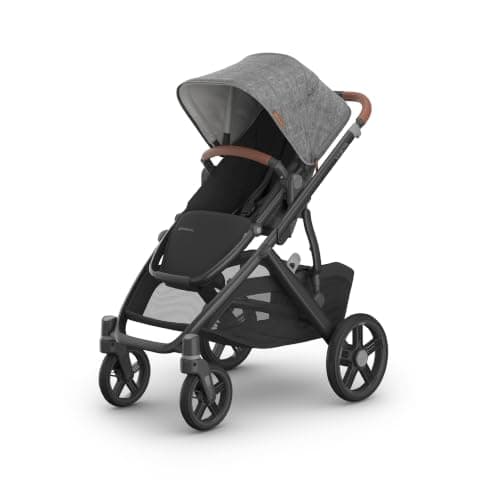
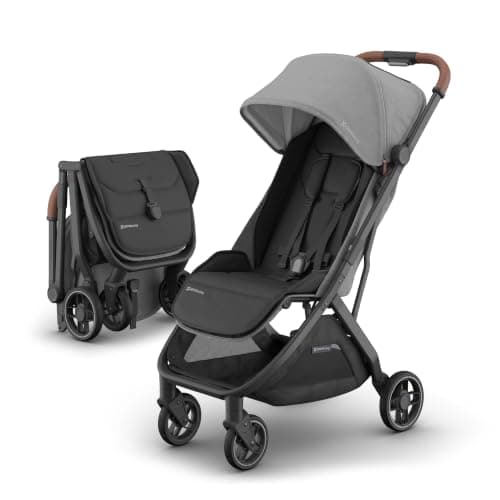
Buy the Vista V3 if you expect a second child, and buy the Minu V3 if you fly. That is genuinely the whole decision. The Vista converts from single to double to triple on one frame — UPPAbaby claims more than 30 configurations — and it is the stroller you push every day for five years. The Minu folds to roughly 10 by 18 by 21.5 inches, stands up on its own, and is rated from birth on its own seat, which almost no compact stroller is. If you can only own one and you have one child who does not fly much, the Minu is enough. If you can only own one and a sibling is likely, it is the Vista.
One honest caveat before the detail, in keeping with how we pick: we have not run both of these for a year. What follows is built from the specifications UPPAbaby and its authorized retailers publish, the current Amazon listings, and the federal stroller standard we cite on every stroller page. Where retailers publish slightly different numbers for the same measurement, we give both rather than choosing the flattering one.
The specifications, side by side
What is actually in each box
This is where buyers get caught, and it is the Vista's problem rather than the Minu's. The Vista V2 shipped with a bassinet; the V3 does not. The V3 carton holds the stroller, the toddler seat and canopy, a seasonal seat liner, bug and rain shields, a storage bag and a three-year warranty. The bassinet is a separate purchase.
Because the Vista's toddler seat is rated from around three months, a newborn cannot ride on it. So the real comparison for a first-time parent is not “Vista versus Minu” — it is “Vista plus a bassinet, or an infant seat with adapters, versus a Minu that works from birth out of the box.” Priced that way, the gap is wider than the shelf price suggests. Our full Vista V3 review goes through the carton contents and the V2-to-V3 changes in detail.
The handlebar, which decides it for some households outright
The Vista's handlebar telescopes; the Minu's does not adjust at all. For two parents of similar height this barely registers. For a household where one parent is 6 foot 2 and the other is 5 foot 3, or for a single tall parent, it is the difference between a stroller you can push for an hour and one you cannot. UPPAbaby's retailers publish an unfolded height range of roughly 36.5 to 39.5 inches for the Vista, which is the tallest published handle figure among the strollers we list.
This is the one area where the Minu has a straightforward weakness, and it is why it does not appear on our strollers for tall parents page despite being our top compact pick overall. If the fixed handle is a problem for you, the third stroller on this page is the answer.
The third option, because the Minu is expensive for what it is
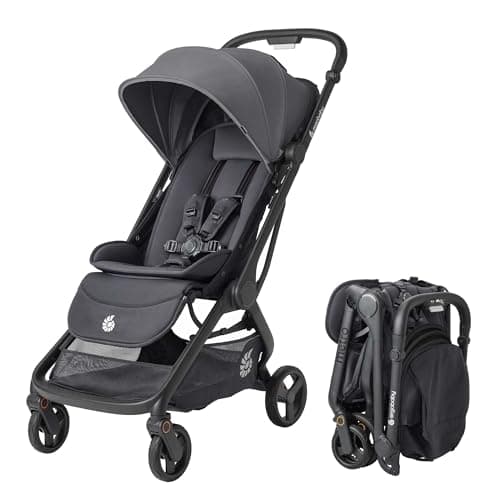
The Ergobaby Metro 3 does the Minu's core job — a compact stroller usable from birth without buying a separate kit — at the same 16.7 pounds, for meaningfully less money, and with an adjustable handlebar the Minu does not have. What you give up is the Minu's IATA-compatible fold, its all-wheel suspension and its 20-pound basket, plus the long track record: the Metro 3 is newer, so there is less owner feedback on how it ages.
Put plainly: if the reason you want a Minu is flying, buy the Minu — the overhead-bin fold is the thing you are paying for and the Metro 3 does not match it. If the reason is “a nice small stroller from birth,” the Metro 3 is the better value and the better fit for a tall parent. Our lightweight stroller roundup ranks the whole compact field, including the 14-pound options that beat both on weight alone.
Can one stroller do both jobs?
Reasonably often, yes — in one direction only. A Minu can be your everyday stroller; it is rated to 50 pounds, it has suspension and a usable basket, and plenty of families never own anything else. A Vista cannot be your travel stroller. At about 27 pounds and 17 by 26 by 34 inches folded with the seat on, it is a car-boot stroller. Taking the seat off drops the folded depth to around 13 inches, which helps in a small trunk and does nothing for an airport.
So the one-stroller answer is: Minu if you have one child and travel; Vista if a second child is likely, accepting that you will probably buy something small later anyway. The two-stroller answer, which is what most Vista owners end up at, is a Vista for home and something 14 pounds or under for trips. If that is where you are heading, read Vista vs Graco Modes Nest first — the mainstream full-size frame does most of the Vista's daily job for a fraction of the price, which changes the maths on owning two.
Both strollers are covered by the same federal carriage and stroller standard, which sets the brake, stability and restraint requirements; neither has a safety advantage over the other on that basis.