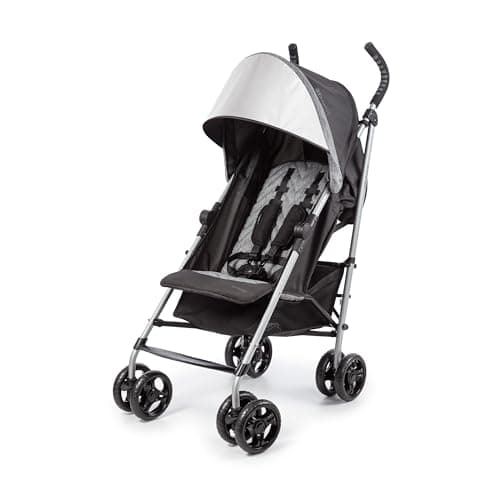
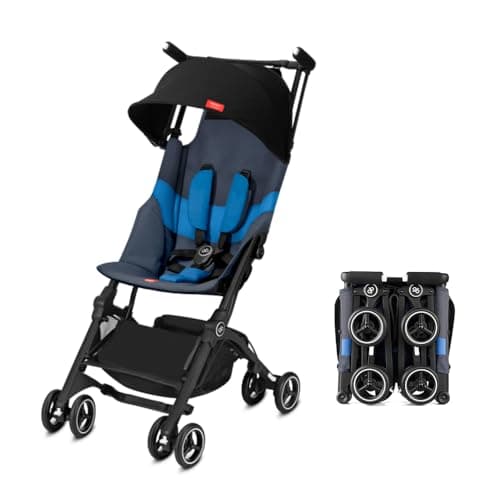
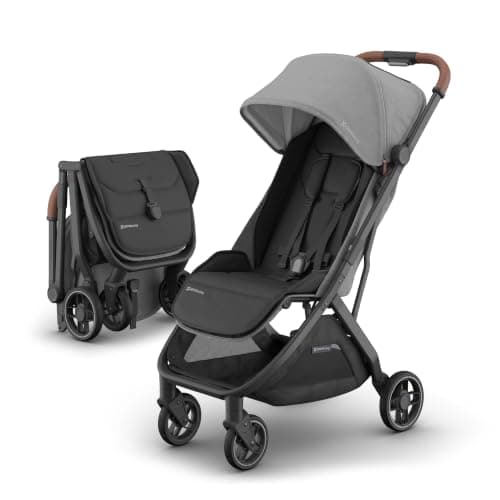
Buy an umbrella stroller if you want the cheapest, lightest second stroller to throw in a car boot. Buy a compact travel stroller if it has to be your only stroller, or if it has to go in an aircraft overhead bin. The dividing line is the fold: an umbrella stroller collapses along one axis into a long, thin bundle, while a compact travel stroller folds in two or three directions into a short block you can carry by a strap.
Neither term is regulated, which is why listings use them loosely. Every stroller sold in the US — umbrella, compact or full-size — has to comply with 16 CFR Part 1227, which incorporates ASTM F833 and covers stability, brakes, restraints and locking mechanisms. That baseline is identical at every price, so this is a usability decision, not a safety one.
What an umbrella stroller is
Twin curved handles, a frame that folds like an umbrella, and a short list of features. The classic version is bare-bones: small wheels, a token canopy, little or no recline, and a basket that holds a phone and not much else. The payoff is that it is light, cheap and nearly disposable in the best sense — you leave it in a car boot or at a grandparent's house and do not mind.
The modern versions blur the line. A steel-framed umbrella-style stroller at around 13 pounds can bring a multi-position, near-flat recline and a genuinely large basket, which used to be the preserve of full-size strollers. If your need is “a light stroller for a toddler who still naps”, that is the sweet spot of the whole category.
What a compact travel stroller is
A single-piece frame that folds small in every dimension, usually with a carry strap or a bag, a proper canopy, some suspension, and — in a few cases — a manufacturer rating for use from birth on the stroller seat itself. They weigh roughly 12 to 18 pounds, which means the lightest umbrella strollers are actually lighter than many “travel” strollers; weight is not what you are paying for. You are paying for folded volume, ride quality and the age rating.
Folded depth, not weight, is what decides whether a stroller fits an aircraft overhead bin — and no airline is obliged to let you try. Gate-checking at the jet bridge is free on US carriers, so treat bin fit as a bonus rather than a plan.
Four strollers, four different answers
How to choose between them
Is this your only stroller? Then buy the compact travel stroller. You need a real canopy, a basket that holds a changing bag, suspension for the pavement you walk every day, and ideally an age rating that starts at birth. An umbrella stroller as an only stroller works from toddlerhood, not from a newborn.
Is it a second stroller? Then the umbrella stroller is almost always the better value. It lives in the boot, it goes to the grandparents, it gets scuffed, and you did not pay enough for that to hurt.
Does it have to recline? This is where the modern umbrella strollers win and the ultra-compacts lose. A semi-reclining seat is a poor napping seat for a long day out; a near-flat multi-position recline is a good one. Check the recline before the weight.
Does it have to fly? Then the published folded dimensions are the only number that matters, and an ultra-compact fold is the one to buy. Remember that the smallest folds are also the ones with the thinnest seat padding and the shortest canopies.
How old is your child? Several of the smallest-folding strollers start at 6 months, not birth. If you are shopping before the birth, that disqualifies them as a first stroller however good the fold is.
How tall are the people pushing it?This is the overlooked one. Compact strollers are built short, and most of them have a fixed handlebar — the UPPAbaby Minu V3 does, which is a real limitation if the parents differ in height. A handful of compact strollers offer an adjustable handlebar (the Ergobaby Metro 3 is the one we know of in this class), and if one of you is over about six feet, that single feature matters more than an inch of folded depth. Kicking the rear axle on every stride is how a stroller ends up unused.
One thing no stroller in this category does, whatever the recline: serve as a safe sleep surface. A reclined stroller seat is not a flat, firm sleep space, and the safe-sleep guidance applies the same way it does at home.
Where to go next
The full ranking of this category, with the folded sizes and the from-birth ratings laid out, is best lightweight & travel strollers. If this will be your only stroller, compare it against the full-size options in best strollers and read how to choose a stroller first. If you are flying, our flying with a baby guide covers gate-checking and what to do with the car seat.